Ch. 4 - Acids and Bases/Electron Flow
Mullins - Organic Chemistry: A Learner Centered Approach 1st Edition
Mullins1st EditionOrganic Chemistry: A Learner Centered ApproachISBN: 9780137566471당신이 사용하는 게 아니라요?교과서 변경
3장, 문제 16b

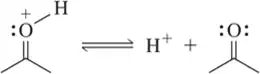
Provide an arrow-pushing mechanism for the following hypothetical acid half-reactions. [These are only intended to help you learn about arrow pushing in acid–base reactions.]
(b) Arrow-pushing mechanism illustrating acid half-reaction with hydroxide ion, proton, and water molecule.

검증된 단계별 안내
1
Step 1: Identify the acid and conjugate base in the reaction. The molecule on the left with the protonated oxygen (O⁺) is the acid, and the molecule on the right with the neutral oxygen is the conjugate base.
Step 2: Recognize the key bond-breaking event. The O-H bond in the acid will break, resulting in the release of a proton (H⁺). This is an acid dissociation reaction.
Step 3: Use curved arrows to show electron movement. Draw a curved arrow starting from the lone pair on the oxygen atom and pointing toward the bond between oxygen and hydrogen. This indicates that the lone pair is forming a double bond with the carbon, while the O-H bond is breaking.
Step 4: Show the formation of the conjugate base. After the O-H bond breaks, the oxygen atom becomes neutral, and the proton (H⁺) is released as a free ion.
Step 5: Verify the charge balance. Ensure that the charge is conserved in the reaction. The acid starts with a positive charge (O⁺), and after dissociation, the conjugate base is neutral, while the released proton carries a positive charge.

비슷한 문제에 대한 검증된 영상 답변:

이 영상 해법은 위 문제에 도움이 된다고 튜터들이 추천한 것입니다.
영상 길이:
1m

주요 개념

질문에 올바르게 답하기 위해 반드시 이해해야 하는 핵심 개념들은 다음과 같습니다.

Acid-Base Reactions

Acid-base reactions involve the transfer of protons (H+) between species. In organic chemistry, acids are proton donors, while bases are proton acceptors. Understanding the role of acids and bases is crucial for predicting the direction of the reaction and the stability of the resulting species.
추천 영상:
02:49
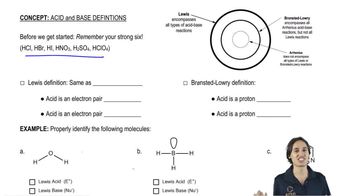
The Lewis definition of acids and bases.

Arrow-Pushing Mechanism

The arrow-pushing mechanism is a method used to illustrate the movement of electrons during chemical reactions. Curved arrows represent the flow of electron pairs, indicating bond formation and breaking. This technique helps visualize the stepwise process of reactions, particularly in acid-base chemistry, where proton transfers are involved.
추천 영상:
04:32
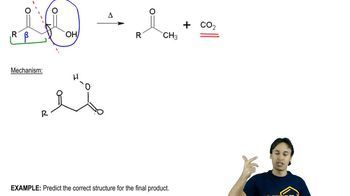
General Mechanism

Resonance Structures

Resonance structures are different ways of drawing the same molecule that illustrate the delocalization of electrons. In acid-base reactions, resonance can stabilize charged intermediates, influencing the reaction pathway and the stability of products. Recognizing resonance is essential for predicting the behavior of reactive intermediates in organic reactions.
추천 영상:
03:04
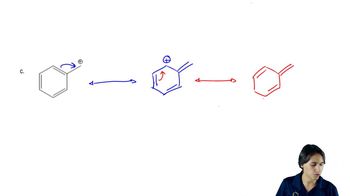
Drawing Resonance Structures