Ch. 5 - Chemical Reaction Analysis: Thermodynamics and Kinetics
Mullins - Organic Chemistry: A Learner Centered Approach 1st Edition
Mullins1st EditionOrganic Chemistry: A Learner Centered ApproachISBN: 9780137566471당신이 사용하는 게 아니라요?교과서 변경
4장, 문제 29c

For the following acid–base reactions studied in Assessment 5.25, draw a likely transition state. Be sure to indicate in your drawing the degree to which bonds are broken or formed.
(c) H3O+ + Br– ⇌ H2O + HBr

검증된 단계별 안내
1
Identify the reactants and products in the given acid-base reaction: H₃O⁺ (hydronium ion) and Br⁻ (bromide ion) are the reactants, while H₂O (water) and HBr (hydrobromic acid) are the products.
Recognize the type of reaction: This is a proton transfer reaction, where the hydronium ion (H₃O⁺) donates a proton (H⁺) to the bromide ion (Br⁻), forming water (H₂O) and hydrobromic acid (HBr).
Understand the transition state: The transition state represents the point in the reaction where bonds are partially broken and formed. In this case, the O-H bond in H₃O⁺ is partially broken, and the H-Br bond is partially formed.
Draw the transition state: Represent the hydronium ion (H₃O⁺) with one of its O-H bonds partially breaking (indicated by a dashed line) and the bromide ion (Br⁻) with a partially forming H-Br bond (also indicated by a dashed line). Use δ⁺ and δ⁻ to show partial charges on the atoms involved in the bond formation and breaking.
Label the transition state: Clearly indicate the transition state with brackets and a double dagger (‡) symbol. Ensure that the drawing reflects the partial bond formation and breaking, as well as the flow of electrons using curved arrows to show the movement of the proton (H⁺) from H₃O⁺ to Br⁻.

비슷한 문제에 대한 검증된 영상 답변:

이 영상 해법은 위 문제에 도움이 된다고 튜터들이 추천한 것입니다.

주요 개념

질문에 올바르게 답하기 위해 반드시 이해해야 하는 핵심 개념들은 다음과 같습니다.

Acid-Base Reactions

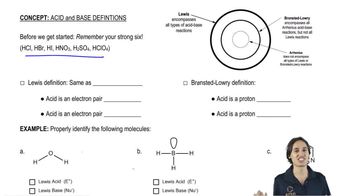
Acid-base reactions involve the transfer of protons (H+) between reactants. In this context, H3O+ acts as the acid, donating a proton, while Br- serves as the base, accepting the proton. Understanding the roles of acids and bases is crucial for predicting the direction of the reaction and the formation of products.
추천 영상:
02:49
The Lewis definition of acids and bases.

Transition States

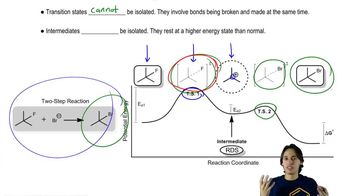
A transition state represents a high-energy, unstable arrangement of atoms that occurs during the transformation from reactants to products. It is characterized by partially formed and broken bonds. Drawing a transition state helps visualize the molecular changes and energy barriers involved in the reaction process.
추천 영상:
06:55
Intermediates vs. Transition States

Bond Formation and Breaking

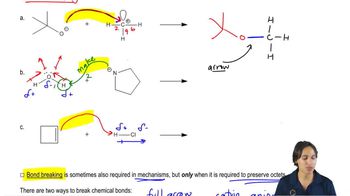
In chemical reactions, bonds between atoms are either formed or broken as reactants convert to products. In the given reaction, H3O+ donates a proton to Br-, leading to the formation of HBr and the breaking of the O-H bond in H3O+. Understanding these changes is essential for accurately depicting the transition state.
추천 영상:
02:31
Identifying Bond Breaking