Ch. 5 - Chemical Reaction Analysis: Thermodynamics and Kinetics
Mullins - Organic Chemistry: A Learner Centered Approach 1st Edition
Mullins1st EditionOrganic Chemistry: A Learner Centered ApproachISBN: 9780137566471당신이 사용하는 게 아니라요?교과서 변경
4장, 문제 10b

For the following equilibrium processes and the corresponding ∆G°, calculate (i) Keq and (ii) the % composition of the equilibrium mixture (% reactants, % products) at 298 K.
(b)

검증된 단계별 안내
1
Step 1: Understand the equilibrium process. The image shows two conformations of a molecule (likely cyclohexane with a methyl group) in equilibrium. The given ΔG° = 0.0 kcal/mol indicates that the Gibbs free energy change for the process is zero, meaning the two conformations are equally stable.
Step 2: Calculate the equilibrium constant (Keq). Use the relationship between ΔG° and Keq: ΔG° = -RT ln(Keq). Since ΔG° = 0, the equation simplifies to ln(Keq) = 0, which implies Keq = 1. This means the reactants and products are present in equal amounts at equilibrium.
Step 3: Determine the % composition of the equilibrium mixture. Since Keq = 1, the ratio of reactants to products is 1:1. This means the equilibrium mixture consists of 50% reactants and 50% products.
Step 4: Convert units if necessary. Ensure that the temperature (T) is in Kelvin (298 K is already provided), and the gas constant (R) is in appropriate units (R = 1.987 cal/(mol·K) or 0.008314 kJ/(mol·K)). These conversions are not needed here since ΔG° = 0.
Step 5: Summarize the findings. The equilibrium constant (Keq) is 1, and the equilibrium mixture consists of 50% reactants and 50% products. This is consistent with the ΔG° value of 0 kcal/mol, indicating no preference for either side of the equilibrium.

비슷한 문제에 대한 검증된 영상 답변:

이 영상 해법은 위 문제에 도움이 된다고 튜터들이 추천한 것입니다.

주요 개념

질문에 올바르게 답하기 위해 반드시 이해해야 하는 핵심 개념들은 다음과 같습니다.

Gibbs Free Energy (∆G°)

Gibbs Free Energy (∆G°) is a thermodynamic potential that indicates the spontaneity of a reaction at constant temperature and pressure. A ∆G° of 0.0 kcal/mol suggests that the reaction is at equilibrium, meaning the rates of the forward and reverse reactions are equal, and there is no net change in the concentrations of reactants and products.
추천 영상:
05:02
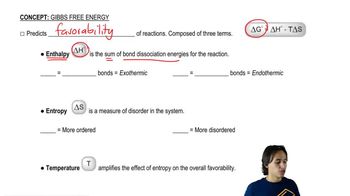
Breaking down the different terms of the Gibbs Free Energy equation.

Equilibrium Constant (K<sub>eq</sub>)

The equilibrium constant (K<sub>eq</sub>) quantifies the ratio of the concentrations of products to reactants at equilibrium for a reversible reaction. It is calculated using the formula K<sub>eq</sub> = [products]/[reactants]. When ∆G° is zero, K<sub>eq</sub> equals 1, indicating that the concentrations of reactants and products are equal at equilibrium.
추천 영상:
02:19
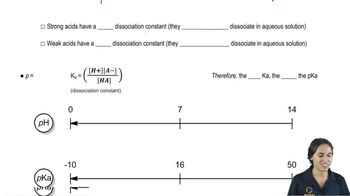
The relationship between equilibrium constant and pKa.

Composition of Equilibrium Mixture

The composition of an equilibrium mixture refers to the percentage of reactants and products present when the system reaches equilibrium. This can be determined using the equilibrium constant and the initial concentrations of the reactants. For a reaction with K<sub>eq</sub> = 1, the mixture will consist of 50% reactants and 50% products, reflecting equal concentrations.
추천 영상:
04:00
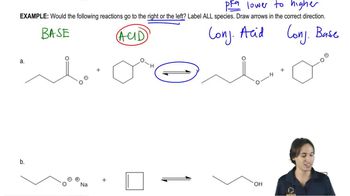
Determining Acid/Base Equilibrium