Ch. 5 - Chemical Reaction Analysis: Thermodynamics and Kinetics
Mullins - Organic Chemistry: A Learner Centered Approach 1st Edition
Mullins1st EditionOrganic Chemistry: A Learner Centered ApproachISBN: 9780137566471당신이 사용하는 게 아니라요?교과서 변경
4장, 문제 27

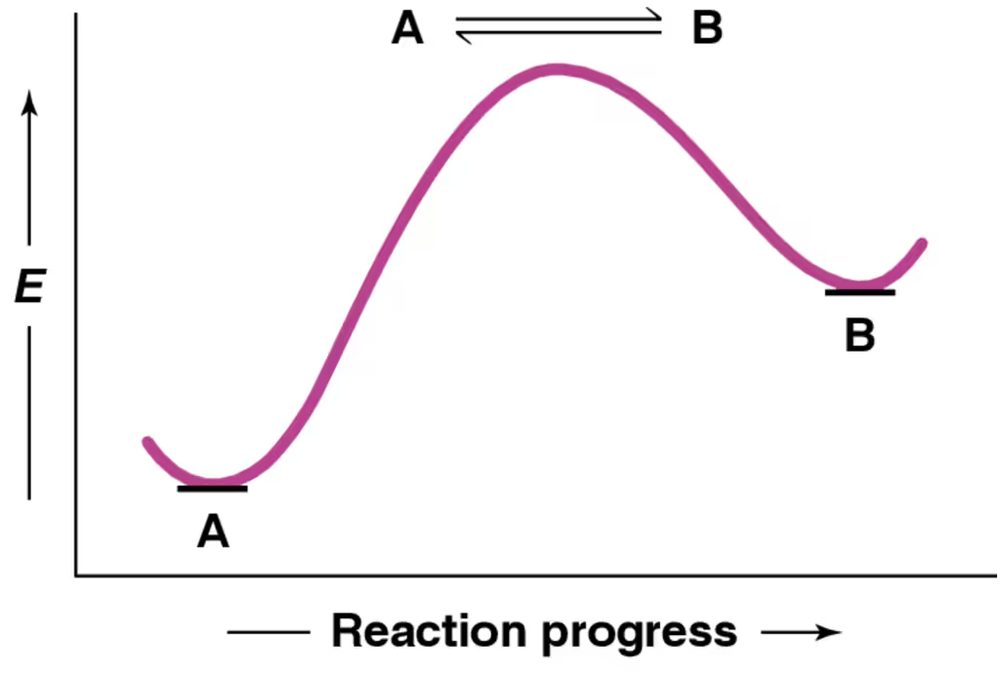
For the reaction coordinate diagram shown, is the forward or reverse reaction faster?
Energy diagram showing the reaction progress from A to B, indicating the relative speeds of forward and reverse reactions.

검증된 단계별 안내
1
Examine the reaction coordinate diagram carefully. Identify the energy levels of the reactants, products, and the transition state.
Determine the activation energy (Ea) for the forward reaction. This is the energy difference between the reactants and the transition state.
Determine the activation energy (Ea) for the reverse reaction. This is the energy difference between the products and the transition state.
Compare the activation energies for the forward and reverse reactions. The reaction with the lower activation energy will proceed faster because it requires less energy to overcome the energy barrier.
Conclude which reaction is faster based on the comparison of activation energies. Remember, the rate of a reaction is inversely proportional to the activation energy.

비슷한 문제에 대한 검증된 영상 답변:

이 영상 해법은 위 문제에 도움이 된다고 튜터들이 추천한 것입니다.
영상 길이:
1m

주요 개념

질문에 올바르게 답하기 위해 반드시 이해해야 하는 핵심 개념들은 다음과 같습니다.

Reaction Coordinate Diagram

A reaction coordinate diagram visually represents the energy changes during a chemical reaction. It plots the potential energy of the reactants and products against the progress of the reaction. The peaks represent transition states, while valleys indicate stable states. Understanding this diagram is crucial for analyzing the energy barriers for both forward and reverse reactions.
추천 영상:
05:02
Coordination Complexes

Activation Energy

Activation energy is the minimum energy required for a reaction to occur. It is represented by the height of the energy barrier in a reaction coordinate diagram. A lower activation energy indicates a faster reaction, as fewer energy collisions are needed for reactants to convert into products. Comparing the activation energies of the forward and reverse reactions helps determine which is faster.
추천 영상:
08:30
Introduction to free energy diagrams.

Rate of Reaction

The rate of reaction refers to the speed at which reactants are converted into products. It is influenced by factors such as concentration, temperature, and the presence of catalysts. In the context of a reaction coordinate diagram, the rate can be inferred from the activation energy; the reaction with the lower activation energy will generally proceed at a faster rate, allowing for a comparison between the forward and reverse reactions.
추천 영상:
가이드 코스
5:07
Rates of Intramolecular Reactions Concept 2