


Ch. 8 - Alkenes 1: Properties and Electrophilic Additions
Mullins - Organic Chemistry: A Learner Centered Approach 1st Edition
Mullins1st EditionOrganic Chemistry: A Learner Centered ApproachISBN: 9780137566471당신이 사용하는 게 아니라요?교과서 변경
7장, 문제 56

Unlike hydroboration–oxidation, the addition of H2O catalyzed by H3O+ is not stereospecific. Thinking carefully about the mechanism of the reaction, give two reasons why.

검증된 단계별 안내
1
Understand the mechanism of H₂O addition catalyzed by H₃O⁺: This reaction proceeds via an electrophilic addition mechanism where the alkene reacts with H₃O⁺ to form a carbocation intermediate. The carbocation is planar and sp² hybridized, which is key to understanding the lack of stereospecificity.
Reason 1: The carbocation intermediate formed during the reaction is achiral and planar. This allows the nucleophile (H₂O) to attack from either side of the plane with equal probability, leading to the formation of both enantiomers or diastereomers if applicable. This contrasts with hydroboration–oxidation, which involves a concerted mechanism that is stereospecific.
Reason 2: The reaction does not involve a concerted mechanism like hydroboration–oxidation. Instead, the reaction proceeds stepwise, with the formation of an intermediate carbocation. The lack of a concerted mechanism means there is no control over the stereochemistry of the product.
Compare with hydroboration–oxidation: In hydroboration–oxidation, the addition of H and OH occurs in a single step (concerted mechanism), ensuring syn addition and stereospecificity. The absence of such a concerted mechanism in H₃O⁺-catalyzed hydration explains the lack of stereospecificity.
Conclude: The planar nature of the carbocation intermediate and the stepwise mechanism are the two main reasons why the addition of H₂O catalyzed by H₃O⁺ is not stereospecific.

비슷한 문제에 대한 검증된 영상 답변:

이 영상 해법은 위 문제에 도움이 된다고 튜터들이 추천한 것입니다.
영상 길이:
6m

주요 개념

질문에 올바르게 답하기 위해 반드시 이해해야 하는 핵심 개념들은 다음과 같습니다.

Mechanism of Electrophilic Addition

Electrophilic addition involves the attack of an electrophile on a nucleophile, leading to the formation of a carbocation intermediate. In the case of H₂O addition catalyzed by H₃O⁺, the reaction proceeds through a planar carbocation, allowing nucleophilic attack from either side. This lack of preference for one face over the other results in a mixture of stereoisomers, making the reaction non-stereospecific.
추천 영상:
05:39
Features of Addition Mechanisms.

Carbocation Stability and Rearrangement

Carbocations are positively charged species that can undergo rearrangements to form more stable structures. During the addition of H₂O in the presence of H₃O⁺, the carbocation can rearrange to a more stable form before the nucleophilic attack occurs. This potential for rearrangement further complicates the stereochemical outcome, as different pathways can lead to different products.
추천 영상:
05:58
Determining Carbocation Stability

Stereospecificity vs. Stereoselectivity

Stereospecificity refers to reactions where the configuration of the reactant directly determines the configuration of the product, leading to a single stereoisomer. In contrast, stereoselectivity allows for the formation of multiple stereoisomers, with one being favored. The addition of H₂O in the presence of H₃O⁺ is stereoselective rather than stereospecific, as it can yield both enantiomers due to the non-preferential attack on the planar carbocation.
추천 영상:
03:06
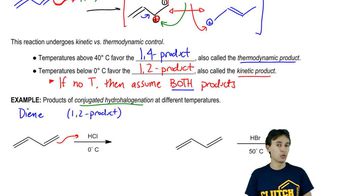
1,2 vs. 1,4 products