
Ch.1 - Structure and Bonding
Wade - Organic Chemistry 9th Edition
Wade9th EditionOrganic ChemistryISBN: 9780135213728당신이 사용하는 게 아니라요?교과서 변경
1장, 문제 1

For each of the following compounds, 1. Give the hybridization and approximate bond angles around each atom except hydrogen. 2. Draw a three-dimensional diagram, including any lone pairs of electrons. d. (CH3)3N e. [CH3NH3]+ f. CH3COOH

검증된 단계별 안내
1
Identify the central atoms in each compound and determine the number of electron groups (bonds and lone pairs) around them.
For each central atom, use the VSEPR theory to determine the hybridization based on the number of electron groups: sp (2 groups), sp2 (3 groups), sp3 (4 groups), etc.
Estimate the bond angles based on the hybridization: sp (180°), sp2 (120°), sp3 (109.5°), and adjust for lone pairs if necessary.
Draw a three-dimensional structure for each compound, showing the arrangement of atoms and lone pairs around the central atoms.
Label the hybridization and bond angles on the diagram for each central atom, ensuring to include any lone pairs in the depiction.

비슷한 문제에 대한 검증된 영상 답변:

이 영상 해법은 위 문제에 도움이 된다고 튜터들이 추천한 것입니다.
영상 길이:
8m

주요 개념

질문에 올바르게 답하기 위해 반드시 이해해야 하는 핵심 개념들은 다음과 같습니다.

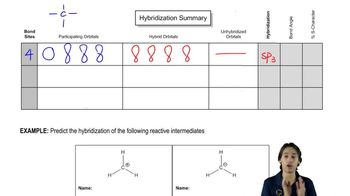
Hybridization

Hybridization is the concept of mixing atomic orbitals to form new hybrid orbitals that can accommodate the bonding requirements of a molecule. For example, in (CH3)3N, the nitrogen atom undergoes sp3 hybridization, resulting in four equivalent hybrid orbitals that form sigma bonds with three methyl groups and one lone pair.
추천 영상:
10:43
Using bond sites to predict hybridization

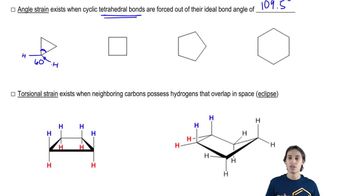
Bond Angles

Bond angles are the angles formed between adjacent bonds in a molecule, which are influenced by the hybridization of the central atom and the presence of lone pairs. In (CH3)3N, the bond angles are approximately 109.5 degrees due to its tetrahedral geometry, while in [CH3NH3]+, the angles are also close to this value, reflecting its sp3 hybridization.
추천 영상:
02:46
What is angle strain?

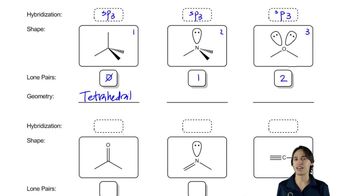
Three-Dimensional Molecular Geometry

Three-dimensional molecular geometry describes the spatial arrangement of atoms in a molecule, which can be represented using models that show bond angles and lone pairs. For instance, in CH3COOH, the carboxylic acid group has a planar arrangement around the carbon atom, while the overall structure can be depicted using wedge-and-dash notation to indicate the three-dimensional orientation of bonds.
추천 영상:
07:44
Molecular Geometry Explained.