Ch. 2 - Acids and Bases; Functional Groups
Wade - Organic Chemistry 9th Edition
Wade9th EditionOrganic ChemistryISBN: 9780135213728당신이 사용하는 게 아니라요?교과서 변경
2장, 문제 3g,h,i

1. Draw the Lewis structure.
2. Show how the bond dipole moments (and those of any nonbonding pairs of electrons) contribute to the molecular dipole moment.
3. Estimate whether the compound will have a large, small, or zero dipole moment.
g. HCN
h. CH3CHO
i. H2C=NH

검증된 단계별 안내
1
Step 1: Begin by drawing the Lewis structure for each molecule. For HCN, identify the central carbon atom bonded to hydrogen and nitrogen. For CH3CHO, recognize the aldehyde group with a carbonyl bond. For H2C=NH, note the double bond between carbon and nitrogen.
Step 2: Assign formal charges and check for resonance structures if applicable. Ensure that each atom satisfies the octet rule where possible, and adjust for any formal charges.
Step 3: Identify the bond dipole moments. For HCN, consider the electronegativity difference between hydrogen, carbon, and nitrogen. For CH3CHO, focus on the polar C=O bond. For H2C=NH, evaluate the C=N bond polarity.
Step 4: Analyze how these bond dipole moments contribute to the overall molecular dipole moment. Consider the molecular geometry and symmetry to determine if dipoles cancel out or reinforce each other.
Step 5: Estimate the magnitude of the dipole moment. For HCN, expect a significant dipole due to the linear structure and polar bonds. For CH3CHO, anticipate a moderate dipole due to the polar C=O bond. For H2C=NH, predict a small dipole moment due to the geometry and bond polarities.

비슷한 문제에 대한 검증된 영상 답변:

이 영상 해법은 위 문제에 도움이 된다고 튜터들이 추천한 것입니다.
영상 길이:
9m

주요 개념

질문에 올바르게 답하기 위해 반드시 이해해야 하는 핵심 개념들은 다음과 같습니다.

Lewis Structures

Lewis structures are diagrams that represent the bonding between atoms of a molecule and the lone pairs of electrons that may exist. They are essential for visualizing the arrangement of atoms, the distribution of electrons, and the connectivity within a molecule, which is crucial for predicting molecular geometry and reactivity.
추천 영상:
04:12
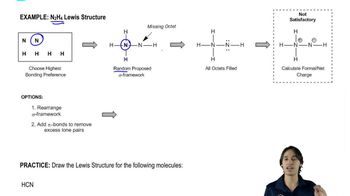
Drawing the Lewis Structure for N2H4.

Bond Dipole Moments

Bond dipole moments occur due to differences in electronegativity between bonded atoms, resulting in a separation of charge. This concept is important for understanding how individual bond polarities contribute to the overall molecular dipole moment, which affects the molecule's physical properties and interactions with other molecules.
추천 영상:
01:46
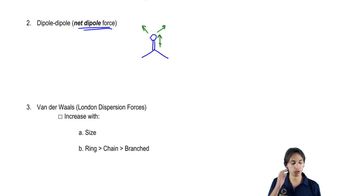
How dipole-dipole forces work.

Molecular Dipole Moment

The molecular dipole moment is a vector sum of all individual bond dipoles and lone pair contributions in a molecule. It determines the molecule's polarity, influencing its solubility, boiling point, and interaction with electric fields. Estimating the dipole moment involves considering both the magnitude and direction of each bond dipole within the molecular geometry.
추천 영상:
01:46
How dipole-dipole forces work.