Ch. 2 - Acids and Bases; Functional Groups
Wade - Organic Chemistry 9th Edition
Wade9th EditionOrganic ChemistryISBN: 9780135213728당신이 사용하는 게 아니라요?교과서 변경
2장, 문제 21f,g

Choose the more acidic member of each pair of isomers, and show why the acid you chose is more acidic.
(f)
(g)

검증된 단계별 안내
1
Identify the functional groups present in each isomer. In the first pair, both isomers have a hydroxyl group (OH) and a carbonyl group (C=O) attached to a furan ring. In the second pair, both isomers have an ammonium group (NH3+) and a carbonyl group (C=O) attached to a cyclohexene ring.
For the first pair, consider the position of the hydroxyl group relative to the carbonyl group. The acidity of the hydroxyl group can be influenced by the electron-withdrawing effect of the carbonyl group. The closer the hydroxyl group is to the carbonyl group, the more acidic it is due to increased stabilization of the conjugate base.
For the second pair, analyze the position of the ammonium group relative to the carbonyl group. The acidity of the ammonium group can be affected by the electron-withdrawing effect of the carbonyl group. The closer the ammonium group is to the carbonyl group, the more acidic it is due to increased stabilization of the conjugate base.
Consider resonance effects in both pairs. In the first pair, the conjugate base formed after deprotonation of the hydroxyl group can be stabilized by resonance with the carbonyl group. In the second pair, the conjugate base formed after deprotonation of the ammonium group can also be stabilized by resonance with the carbonyl group.
Compare the overall electron-withdrawing effects and resonance stabilization in each pair to determine which isomer is more acidic. The isomer with the hydroxyl or ammonium group closer to the carbonyl group and better resonance stabilization will be more acidic.

비슷한 문제에 대한 검증된 영상 답변:

이 영상 해법은 위 문제에 도움이 된다고 튜터들이 추천한 것입니다.
영상 길이:
14m

주요 개념

질문에 올바르게 답하기 위해 반드시 이해해야 하는 핵심 개념들은 다음과 같습니다.

Acidity and pKa

Acidity in organic chemistry is often measured by the pKa value, which indicates the strength of an acid. A lower pKa value corresponds to a stronger acid, meaning it more readily donates a proton (H+). Understanding pKa is crucial for comparing the acidity of different compounds, as it provides a quantitative measure of their acidic strength.
추천 영상:
07:45
Identifying pKa values

Resonance Stabilization

Resonance stabilization occurs when a molecule can distribute its charge over multiple atoms through resonance structures. This delocalization of charge can stabilize the conjugate base of an acid, making the original acid more acidic. In the context of the given isomers, the ability of the conjugate base to be resonance-stabilized will influence which isomer is more acidic.
추천 영상:
03:43
The radical stability trend.

Inductive Effect

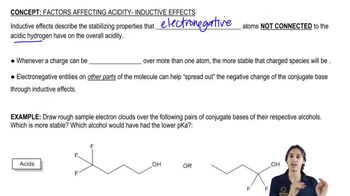
The inductive effect refers to the electron-withdrawing or electron-donating properties of substituents in a molecule, which can affect acidity. Electron-withdrawing groups can stabilize the negative charge on the conjugate base, increasing acidity. In the isomers shown, the position of the carbonyl group relative to the hydroxyl group can influence the acidity through the inductive effect.
추천 영상:
01:47
Understanding the Inductive Effect.