
Ch.11 - Reactions of Alcohols
Wade - Organic Chemistry 9th Edition
Wade9th EditionOrganic ChemistryISBN: 9780135213728당신이 사용하는 게 아니라요?교과서 변경
11장, 문제 61

Chromic acid oxidation of an alcohol (Section 11-2A) occurs in two steps: formation of the chromate ester, followed by an elimination of H+ and chromium. Which step do you expect to be rate-limiting? Careful kinetic studies have shown that Compound A undergoes chromic acid oxidation over 10 times as fast as Compound B. Explain this large difference in rates.
Chemical structures of Compound A and Compound B, illustrating chromic acid oxidation with rate differences noted.

검증된 단계별 안내
1
Step 1: Understand the chromic acid oxidation mechanism. Chromic acid oxidation of alcohols involves two key steps: (1) formation of a chromate ester intermediate, and (2) elimination of H+ and chromium to form the oxidized product. The rate-limiting step is typically the formation of the chromate ester, as it involves bond formation and rearrangement.
Step 2: Analyze the structures of Compound A and Compound B. Compound A has a secondary alcohol group, while Compound B has a primary alcohol group. The steric and electronic environment around the alcohol group influences the rate of chromate ester formation.
Step 3: Consider steric hindrance. Compound A has a methyl group adjacent to the alcohol, which can stabilize the transition state during chromate ester formation. In contrast, Compound B lacks this stabilizing group, making the transition state less favorable and slowing down the reaction.
Step 4: Evaluate electronic effects. The methyl group in Compound A can donate electron density through hyperconjugation, stabilizing the intermediate formed during chromate ester formation. Compound B does not have this stabilizing effect, contributing to its slower reaction rate.
Step 5: Conclude the explanation. The large difference in rates between Compound A and Compound B is due to the steric and electronic stabilization provided by the methyl group in Compound A, which facilitates faster formation of the chromate ester intermediate, the rate-limiting step in the reaction.

비슷한 문제에 대한 검증된 영상 답변:

이 영상 해법은 위 문제에 도움이 된다고 튜터들이 추천한 것입니다.
영상 길이:
7m

주요 개념

질문에 올바르게 답하기 위해 반드시 이해해야 하는 핵심 개념들은 다음과 같습니다.

Chromic Acid Oxidation Mechanism

Chromic acid oxidation of alcohols involves a two-step mechanism. The first step is the formation of a chromate ester, where the alcohol reacts with chromic acid to form a transient intermediate. The second step involves the elimination of H+ and chromium species, leading to the formation of the carbonyl compound. Understanding this mechanism is crucial for identifying which step may be rate-limiting.
추천 영상:
01:31
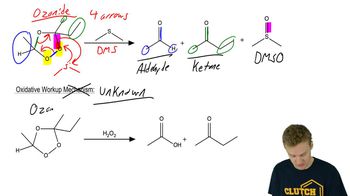
Oxidative Workup Mechanism:

Rate-Limiting Step

The rate-limiting step in a reaction mechanism is the slowest step that determines the overall reaction rate. In the context of chromic acid oxidation, identifying whether the formation of the chromate ester or the elimination step is rate-limiting is essential for predicting reaction kinetics. This concept is fundamental in understanding how different factors can influence the speed of chemical reactions.
추천 영상:
10:14
Limitations

Kinetic Studies and Reactivity

Kinetic studies involve measuring the rates of reactions to understand how different compounds react under similar conditions. The observation that Compound A undergoes chromic acid oxidation over 10 times faster than Compound B suggests significant differences in their structures or steric effects, which can influence the stability of intermediates and transition states. This concept helps explain variations in reactivity among different alcohols.
추천 영상:
08:51
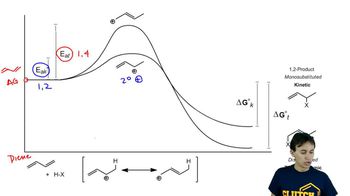
Kinetic vs. Thermodynamic Control
관련 실천
교과서 질문

The Williamson ether synthesis involves the displacement of an alkyl halide or tosylate by an alkoxide ion. Would the synthesis shown be possible by making a tosylate and displacing it? If so, show the sequence of reactions. If not, explain why not and show an alternative synthesis that would be more likely to work.

973
views
교과서 질문

Two unknowns, X and Y, both having the molecular formula C4H8O, give the following results with four chemical tests. Propose structures for X and Y consistent with this information.

1609
views
교과서 질문

(b) Under the same conditions, an optically active sample of trans-2-bromocyclopentanol reacts with concentrated aqueous HBr to give an optically inactive product, (racemic) trans-1,2-dibromocyclopentane. Propose a mechanism to show how this reaction goes with apparently complete retention of configuration, yet with racemization. (Hint: Draw out the mechanism of the reaction of cyclopentene with Br2 in water to give the starting material, trans-2- bromocyclopentanol. Consider how parts of this mechanism might be involved in the reaction with HBr.)

1075
views
교과서 질문

(a) The reaction of butan-2-ol with concentrated aqueous HBr goes with partial racemization, giving more inversion than retention of configuration. Propose a mechanism that accounts for racemization with excess inversion.

1466
views
교과서 질문

The following pseudo-syntheses (guaranteed not to work) exemplify a common conceptual error.

(a) What is the conceptual error implicit in these syntheses?

(b) Propose syntheses that are more likely to succeed.

766
views
교과서 질문

Alcohols combine with ketones and aldehydes to form interesting derivatives, which we will discuss in Chapter 18. The following reactions show the hydrolysis of two such derivatives. Propose mechanisms for these reactions.

(a)

824
views