
Ch.11 - Reactions of Alcohols
Wade - Organic Chemistry 9th Edition
Wade9th EditionOrganic ChemistryISBN: 9780135213728당신이 사용하는 게 아니라요?교과서 변경
11장, 문제 57

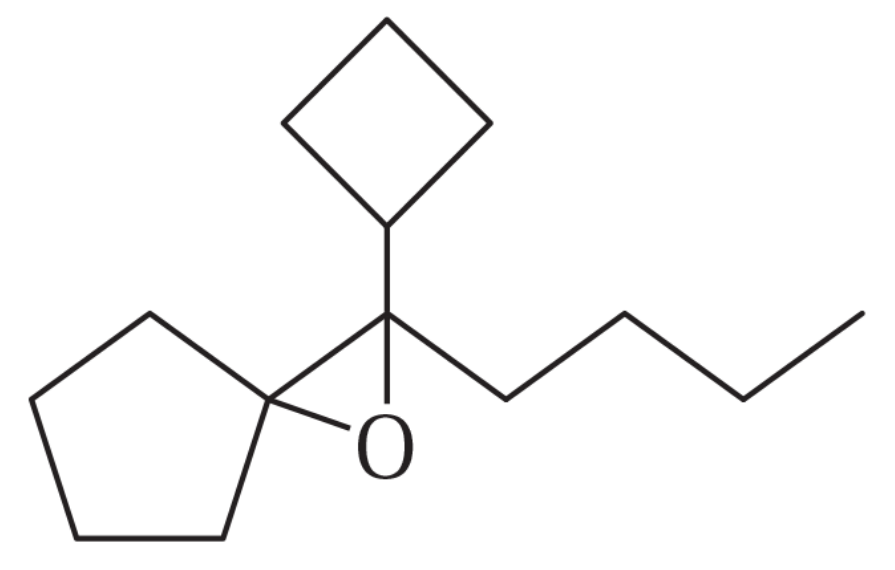
Show how you would synthesize the following compound. As starting materials, you may use any alcohols containing five or fewer carbon atoms and any necessary solvents and inorganic reagents.

검증된 단계별 안내
1
Step 1: Analyze the target molecule. The compound contains a cyclopentane ring, a cyclohexane ring, and an ether functional group connecting a cyclopentyl group to a butyl group. This suggests that the synthesis will involve forming an ether bond through an SN2 reaction or Williamson ether synthesis.
Step 2: Identify the alcohols and reagents needed. To synthesize the ether, you can use cyclopentanol (C5H10O) and 1-bromobutane (C4H9Br) as starting materials. Cyclopentanol will act as the nucleophile, and 1-bromobutane will act as the electrophile.
Step 3: Convert cyclopentanol into cyclopentoxide. Treat cyclopentanol with a strong base such as sodium hydride (NaH) or potassium tert-butoxide (KOtBu) to deprotonate the alcohol and form the cyclopentoxide ion (C5H9O⁻). This step generates a strong nucleophile for the ether synthesis.
Step 4: Perform the Williamson ether synthesis. React the cyclopentoxide ion with 1-bromobutane in an SN2 reaction. The nucleophilic cyclopentoxide ion attacks the electrophilic carbon in 1-bromobutane, displacing the bromide ion and forming the ether bond.
Step 5: Purify the product. After the reaction, isolate the desired ether compound by techniques such as distillation or chromatography to remove any unreacted starting materials and byproducts.

비슷한 문제에 대한 검증된 영상 답변:

이 영상 해법은 위 문제에 도움이 된다고 튜터들이 추천한 것입니다.
영상 길이:
17m

주요 개념

질문에 올바르게 답하기 위해 반드시 이해해야 하는 핵심 개념들은 다음과 같습니다.

Alcohols and Their Reactivity

Alcohols are organic compounds containing one or more hydroxyl (-OH) groups. Their reactivity is influenced by the structure of the alcohol, such as whether it is primary, secondary, or tertiary. Understanding how these alcohols can undergo reactions like dehydration, oxidation, or substitution is crucial for synthesizing complex compounds.
추천 영상:
01:01
How to name alcohols

Synthetic Pathways

Synthetic pathways refer to the series of chemical reactions used to convert starting materials into a desired product. This involves selecting appropriate reagents and conditions to facilitate each step. Knowledge of various synthetic strategies, such as functional group transformations and coupling reactions, is essential for effective compound synthesis.
추천 영상:
가이드 코스
2:13
Energy Production In Biochemical Pathways Concept 1

Solvents and Reaction Conditions

The choice of solvent and reaction conditions can significantly affect the outcome of a chemical reaction. Solvents can influence solubility, reaction rates, and selectivity. Understanding the properties of solvents, such as polarity and boiling point, is important for optimizing reactions and ensuring successful synthesis of the target compound.
추천 영상:
02:26
General format of reactions and how to interpret solvents.
관련 실천