

Ch. 13 - Nuclear Magnetic Resonance Spectroscopy
Wade - Organic Chemistry 9th Edition
Wade9th EditionOrganic ChemistryISBN: 9780135213728당신이 사용하는 게 아니라요?교과서 변경
13장, 문제 45

When 2-chloro-2-methylbutane is treated with a variety of strong bases, the products always seem to contain two isomers (A and B) of formula C5H10. When sodium hydroxide is used as the base, isomer A predominates. When potassium tert-butoxide is used as the base, isomer B predominates. The 1H and 13C NMR spectra of A and B are given below.
(a) Determine the structures of isomers A and B.
(b) Explain why A is the major product when using sodium hydroxide as the base and why B is the major product when using potassium tert-butoxide as the base.
<IMAGE>

검증된 단계별 안내
1
Step 1: Analyze the reaction conditions and the starting material. The starting material, 2-chloro-2-methylbutane, is a tertiary alkyl halide. When treated with strong bases, elimination reactions (E2 mechanism) are likely to occur, leading to the formation of alkenes. The molecular formula of the products (C5H10) indicates that the products are alkenes formed by the elimination of HCl.
Step 2: Identify the possible alkenes (isomers A and B) that can form. The elimination of HCl from 2-chloro-2-methylbutane can lead to two regioisomeric alkenes: (1) 2-methyl-2-butene (a more substituted alkene) and (2) 2-methyl-1-butene (a less substituted alkene). These correspond to the two isomers A and B. The more substituted alkene is typically more stable due to hyperconjugation and alkyl group stabilization (Zaitsev's rule).
Step 3: Examine the role of the base in determining the major product. Sodium hydroxide (NaOH) is a smaller, less sterically hindered base, which favors the formation of the more substituted alkene (2-methyl-2-butene, isomer A) via Zaitsev's rule. Potassium tert-butoxide, on the other hand, is a bulky base, which favors the formation of the less substituted alkene (2-methyl-1-butene, isomer B) due to steric hindrance (Hofmann product).
Step 4: Use the provided NMR data to confirm the structures of isomers A and B. Analyze the 1H and 13C NMR spectra for each isomer. For isomer A (2-methyl-2-butene), expect signals corresponding to a more symmetrical structure with fewer unique hydrogen and carbon environments. For isomer B (2-methyl-1-butene), expect signals corresponding to a less symmetrical structure with more unique environments. Compare the chemical shifts, splitting patterns, and integration values to assign the structures.
Step 5: Summarize the reasoning. Isomer A (2-methyl-2-butene) is the major product with sodium hydroxide due to Zaitsev's rule, as the smaller base allows for the formation of the more substituted alkene. Isomer B (2-methyl-1-butene) is the major product with potassium tert-butoxide due to steric hindrance, which favors the less substituted alkene (Hofmann product). The NMR data confirms the structures of the two isomers.

비슷한 문제에 대한 검증된 영상 답변:

이 영상 해법은 위 문제에 도움이 된다고 튜터들이 추천한 것입니다.
영상 길이:
10m

주요 개념

질문에 올바르게 답하기 위해 반드시 이해해야 하는 핵심 개념들은 다음과 같습니다.

Elimination Reactions

Elimination reactions involve the removal of a small molecule, such as HCl or H2O, from a larger molecule, resulting in the formation of a double bond. In the context of 2-chloro-2-methylbutane, strong bases facilitate the elimination of HCl, leading to the formation of alkenes. The nature of the base can influence the pathway of the elimination, resulting in different isomers.
추천 영상:
00:40
Recognizing Elimination Reactions.

Zaitsev's Rule

Zaitsev's Rule states that in elimination reactions, the more substituted alkene is generally the major product. This is due to the stability of more substituted double bonds, which are favored in thermodynamic conditions. When sodium hydroxide is used, it tends to favor the formation of the more stable alkene (isomer A), while potassium tert-butoxide, being a bulkier base, favors the less substituted alkene (isomer B) due to steric hindrance.
추천 영상:
01:18
Defining Zaitsev’s Rule

NMR Spectroscopy

Nuclear Magnetic Resonance (NMR) spectroscopy is a powerful analytical technique used to determine the structure of organic compounds. It provides information about the number of hydrogen and carbon atoms in a molecule, as well as their environments. The differences in the NMR spectra of isomers A and B can help identify their structures and confirm the effects of the bases used in the elimination reactions.
추천 영상:
10:06
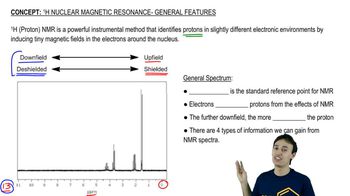
General NMR Features
관련 실천
교과서 질문

A small pilot plant was adding bromine across the double bond of but-2-ene to make 2,3-dibromobutane. A controller malfunction allowed the reaction temperature to rise beyond safe limits. A careful distillation of the product showed that several impurities had formed, including the one having the NMR spectra that appear below. Determine its structure, and assign the peaks to the protons in your structure.

<IMAGE>

1526
views
교과서 질문

Tell precisely how you would use the proton NMR spectra to distinguish between the following pairs of compounds.

(a) 1-bromopropane and 2-bromopropane

1820
views
1
rank
교과서 질문

The three isomers of dimethylbenzene are commonly named ortho-xylene, meta-xylene, and para-xylene. These three isomers are difficult to distinguish using proton NMR, but they are instantly identifiable using 13C NMR.

(a) Describe how carbon NMR distinguishes these three isomers.

(b) Explain why they are difficult to distinguish using proton NMR.

5529
views
교과서 질문

(a) Draw all six isomers of formula C4H8 (including stereoisomers).

(b) For each structure, show how many types of H would appear in the proton NMR spectrum.

(c) For each structure, show how many types of C would appear in the 13C NMR spectrum.

(d) If an unknown compound of formula C4H8 shows two types of H and three types of C, can you determine its structure from this information?

2965
views
교과서 질문

Tell precisely how you would use the proton NMR spectra to distinguish between the following pairs of compounds.

(b)

1199
views
교과서 질문

(A true story.) A major university was designated as a national nuclear magnetic resonance center by the National Science Foundation. Several large superconducting instruments were being installed when a government safety inspector appeared and demanded to know what provisions were being made to handle the nuclear waste produced by these instruments. Assume you are the manager of the NMR center, and offer an explanation that could be understood by a nonscientist.

1429
views