

Ch. 15 - Conjugated Systems, Orbital Symmetry, and Ultraviolet Spectroscopy
Wade - Organic Chemistry 9th Edition
Wade9th EditionOrganic ChemistryISBN: 9780135213728당신이 사용하는 게 아니라요?교과서 변경
15장, 문제 27d

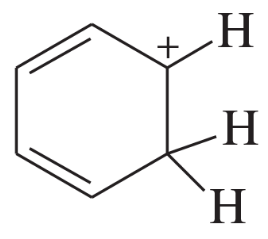
Draw the important resonance contributors for the following cations, anions, and radicals.
(d)

검증된 단계별 안내
1
Identify the structure of the given species (cation, anion, or radical) and locate any atoms with lone pairs, π-bonds, or unfilled octets. These features are key to determining resonance contributors.
Determine the movement of electrons. For resonance structures, electrons can move in the form of lone pairs or π-bonds. Use curved arrows to show the electron flow. For example, a lone pair can form a π-bond, or a π-bond can shift to form a lone pair or move to an adjacent atom.
Draw the new resonance structure after the electron movement. Ensure that all atoms obey the octet rule (if applicable) and that the overall charge of the molecule remains the same.
Repeat the process to identify all possible resonance contributors. Each contributor should differ only in the placement of electrons, not the arrangement of atoms.
Evaluate the stability of each resonance structure. More stable contributors (e.g., those with full octets, minimal formal charges, or charges on more electronegative atoms) will contribute more to the resonance hybrid.

비슷한 문제에 대한 검증된 영상 답변:

이 영상 해법은 위 문제에 도움이 된다고 튜터들이 추천한 것입니다.
영상 길이:
3m

주요 개념

질문에 올바르게 답하기 위해 반드시 이해해야 하는 핵심 개념들은 다음과 같습니다.

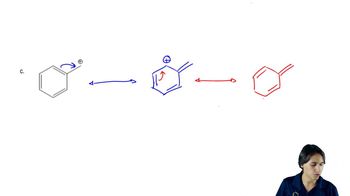
Resonance Structures

Resonance structures are different Lewis structures for the same molecule that depict the delocalization of electrons. They help illustrate how the actual structure is a hybrid of these forms, providing insight into the molecule's stability and reactivity. Understanding resonance is crucial for predicting the behavior of cations, anions, and radicals.
추천 영상:
03:04
Drawing Resonance Structures

Cation, Anion, and Radical Stability

The stability of cations, anions, and radicals is influenced by their electronic structure and the presence of resonance. Cations are stabilized by electron-donating groups, while anions benefit from electron-withdrawing groups. Radicals, having an unpaired electron, are stabilized by resonance as well, which can distribute the unpaired electron over multiple atoms.
추천 영상:
03:43
The radical stability trend.

Electrophiles and Nucleophiles

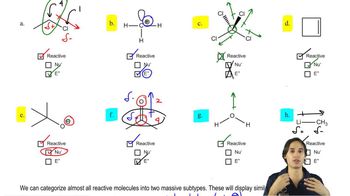
Electrophiles are species that seek electrons and are typically positively charged or electron-deficient, while nucleophiles are electron-rich species that donate electrons. Understanding the roles of these species is essential when analyzing resonance contributors, as they can influence the stability and reactivity of cations, anions, and radicals in organic reactions.
추천 영상:
03:
Nucleophile or Electrophile