Ch. 15 - Conjugated Systems, Orbital Symmetry, and Ultraviolet Spectroscopy
Wade - Organic Chemistry 9th Edition
Wade9th EditionOrganic ChemistryISBN: 9780135213728당신이 사용하는 게 아니라요?교과서 변경
15장, 문제 21

One milligram of a compound of molecular weight 160 is dissolved in 10 mL of ethanol, and the solution is poured into a 1-cm UV cell. The UV spectrum is taken, and there is an absorption at λmax = 247 nm. The maximum absorbance at 247 nm is 0.50. Calculate the value of e for this absorption.

검증된 단계별 안내
1
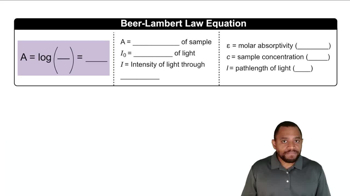
Step 1: Recall the Beer-Lambert Law, which is expressed as: A = ε × c × l, where A is the absorbance, ε is the molar absorptivity (in L·mol⁻¹·cm⁻¹), c is the concentration (in mol·L⁻¹), and l is the path length of the cell (in cm).
Step 2: Identify the given values from the problem: A = 0.50, l = 1 cm, and the molecular weight (MW) of the compound is 160 g/mol. The mass of the compound dissolved is 1 mg (0.001 g), and the volume of the solution is 10 mL (0.01 L).
Step 3: Calculate the concentration (c) of the solution in mol·L⁻¹. Use the formula: c = rac{m}{MW × V}, where m is the mass of the compound, MW is the molecular weight, and V is the volume of the solution in liters.
Step 4: Rearrange the Beer-Lambert Law to solve for ε (molar absorptivity): ε = rac{A}{c × l}. Substitute the values of A, c, and l into this equation.
Step 5: Perform the calculation to determine the value of ε. Ensure the units are consistent throughout the calculation, and the final value of ε will be in L·mol⁻¹·cm⁻¹.

비슷한 문제에 대한 검증된 영상 답변:

이 영상 해법은 위 문제에 도움이 된다고 튜터들이 추천한 것입니다.
영상 길이:
7m

주요 개념

질문에 올바르게 답하기 위해 반드시 이해해야 하는 핵심 개념들은 다음과 같습니다.

Beer-Lambert Law

The Beer-Lambert Law relates the absorbance of light to the properties of the material through which the light is traveling. It states that absorbance (A) is directly proportional to the concentration (c) of the absorbing species, the path length (l) of the light through the sample, and the molar absorptivity (ε) of the substance. The equation is A = εcl, which is essential for calculating the molar absorptivity in this context.
추천 영상:
가이드 코스
1:39
The Beer-Lambert Law Concept 2

Molar Absorptivity (ε)

Molar absorptivity, or molar extinction coefficient (ε), is a measure of how strongly a chemical species absorbs light at a given wavelength. It is expressed in units of L/(mol·cm) and is specific to each substance at a particular wavelength. In this problem, calculating ε will provide insight into the compound's ability to absorb UV light at 247 nm.
추천 영상:
02:02
Major IR absorptions

Concentration Calculation

To apply the Beer-Lambert Law, it is necessary to determine the concentration of the compound in the solution. Concentration (c) can be calculated using the formula c = m/MV, where m is the mass of the solute, M is the molar mass, and V is the volume of the solution in liters. In this case, the concentration will be crucial for finding the molar absorptivity.
추천 영상:
04:37
Draw all of the monochlorination products and calculate percentage yields.