Ch. 15 - Conjugated Systems, Orbital Symmetry, and Ultraviolet Spectroscopy
Wade - Organic Chemistry 9th Edition
Wade9th EditionOrganic ChemistryISBN: 9780135213728당신이 사용하는 게 아니라요?교과서 변경
15장, 문제 14c

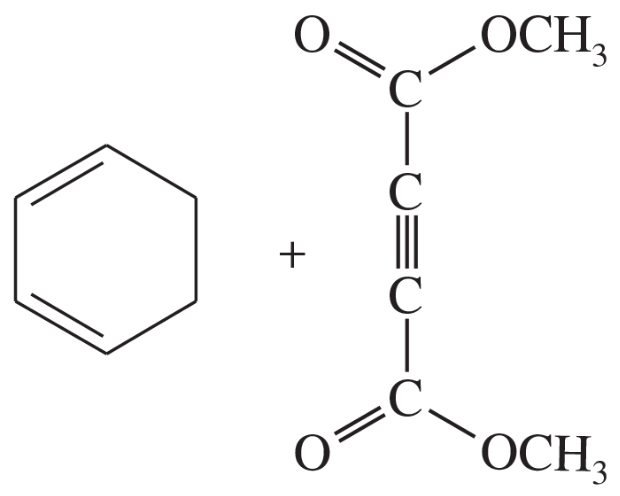
Predict the products of the following proposed Diels–Alder reactions.
(c)

검증된 단계별 안내
1
Step 1: Identify the reactants in the Diels–Alder reaction. The left structure is cyclopentadiene, which acts as the diene (a molecule with two conjugated double bonds). The right structure is a dienophile, specifically a molecule with a triple bond flanked by two cyano groups (-CN). The cyano groups are electron-withdrawing, making the dienophile highly reactive.
Step 2: Recall the mechanism of the Diels–Alder reaction. This reaction is a [4+2] cycloaddition, where the diene contributes four π-electrons and the dienophile contributes two π-electrons. The reaction forms a new six-membered ring.
Step 3: Analyze the regiochemistry. The electron-withdrawing cyano groups on the dienophile will direct the reaction such that the electron-rich ends of the diene align with the electron-deficient ends of the dienophile. This ensures the most stable product.
Step 4: Predict the stereochemistry. The Diels–Alder reaction is stereospecific, meaning that the stereochemistry of the dienophile is preserved in the product. Since the dienophile is linear, the product will not have stereochemical complexity.
Step 5: Draw the product structure. The reaction will result in a six-membered ring with two cyano groups attached to the carbons that were originally part of the triple bond in the dienophile. The double bonds in the diene will be converted into single bonds, and new σ-bonds will form between the diene and dienophile.

비슷한 문제에 대한 검증된 영상 답변:

이 영상 해법은 위 문제에 도움이 된다고 튜터들이 추천한 것입니다.
영상 길이:
4m

주요 개념

질문에 올바르게 답하기 위해 반드시 이해해야 하는 핵심 개념들은 다음과 같습니다.

Diels–Alder Reaction

The Diels–Alder reaction is a [4+2] cycloaddition reaction between a conjugated diene and a dienophile, resulting in the formation of a six-membered ring. This reaction is a key method in organic synthesis for constructing cyclic compounds and is characterized by its stereospecificity and regioselectivity, making it a powerful tool for building complex molecular architectures.
추천 영상:
04:02
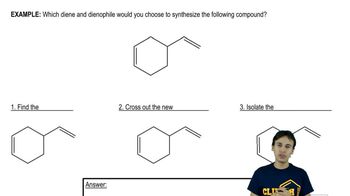
Diels-Alder Retrosynthesis

Diene and Dienophile

In the context of the Diels–Alder reaction, a diene is a molecule that contains two double bonds, which can participate in the reaction, while a dienophile is a compound that contains a double or triple bond and is reactive towards the diene. The reactivity of these components is influenced by their electronic and steric properties, which can affect the outcome of the reaction and the stability of the products formed.
추천 영상:
04:43
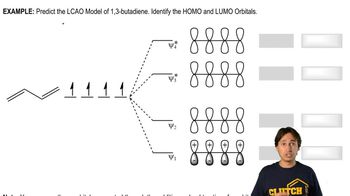
Drawing MO Diagram for Dienes

Regioselectivity and Stereochemistry

Regioselectivity refers to the preference of a chemical reaction to yield one structural isomer over others, while stereochemistry involves the spatial arrangement of atoms in the resulting products. In Diels–Alder reactions, the orientation of substituents on the diene and dienophile can lead to different regioisomers and stereoisomers, which are crucial for predicting the final product's structure and properties.
추천 영상:
가이드 코스
1:38
Polymer Stereochemistry Concept 1