Ch. 15 - Conjugated Systems, Orbital Symmetry, and Ultraviolet Spectroscopy
Wade - Organic Chemistry 9th Edition
Wade9th EditionOrganic ChemistryISBN: 9780135213728당신이 사용하는 게 아니라요?교과서 변경
15장, 문제 8a,b,c

When Br2 is added to buta-1,3-diene at –15 °C, the product mixture contains 60% of product A and 40% of product B. When the same reaction takes place at 60 °C, the product ratio is 10% A and 90% B.
a. Propose structures for products A and B. (Hint: In many cases, an allylic carbocation is more stable than a bromonium ion.)
b. Propose a mechanism to account for formation of both A and B.
c. Show why A predominates at –15 °C and B predominates at 60 °C.

검증된 단계별 안내
1
Step 1: Analyze the reaction conditions and the hint provided. The reaction involves buta-1,3-diene and Br2, which suggests an electrophilic addition mechanism. The hint about allylic carbocations being more stable than bromonium ions indicates that resonance stabilization plays a key role in the formation of products.
Step 2: Propose structures for products A and B. Begin by considering the electrophilic addition of Br2 to buta-1,3-diene. The intermediate formed is likely a resonance-stabilized allylic carbocation. Product A is likely the 1,2-addition product (bromine adds to adjacent carbons), while product B is likely the 1,4-addition product (bromine adds to carbons separated by one double bond). Draw the structures of both products based on these addition patterns.
Step 3: Propose a mechanism for the formation of both A and B. Start with the attack of Br2 on the π-electrons of buta-1,3-diene, forming a bromonium ion or a resonance-stabilized allylic carbocation. Show how the intermediate rearranges to allow for 1,2-addition (leading to product A) and 1,4-addition (leading to product B). Use resonance structures to explain the stability of the intermediate and the formation of both products.
Step 4: Explain why product A predominates at -15 °C and product B predominates at 60 °C. At lower temperatures (-15 °C), the reaction is under kinetic control, favoring the formation of the product that forms faster (product A, 1,2-addition). At higher temperatures (60 °C), the reaction is under thermodynamic control, favoring the more stable product (product B, 1,4-addition). Discuss the energy barriers and stability of the products to support this explanation.
Step 5: Summarize the key concepts involved in this problem: electrophilic addition to conjugated dienes, resonance stabilization of intermediates, and the distinction between kinetic and thermodynamic control. Highlight how temperature influences the product distribution and the importance of understanding reaction mechanisms in organic chemistry.

비슷한 문제에 대한 검증된 영상 답변:

이 영상 해법은 위 문제에 도움이 된다고 튜터들이 추천한 것입니다.
영상 길이:
7m

주요 개념

질문에 올바르게 답하기 위해 반드시 이해해야 하는 핵심 개념들은 다음과 같습니다.

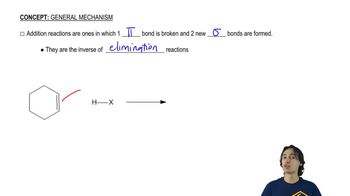
Electrophilic Addition Reactions

Electrophilic addition reactions involve the addition of an electrophile to a nucleophile, typically across a double bond. In the case of buta-1,3-diene reacting with Br2, the double bond acts as a nucleophile, attacking the electrophilic bromine. This reaction can lead to the formation of different products depending on the stability of intermediates formed during the process.
추천 영상:
05:39
Features of Addition Mechanisms.

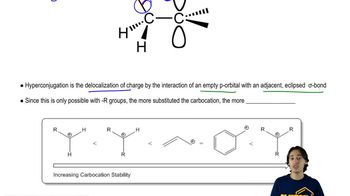
Stability of Carbocations

Carbocations are positively charged carbon species that can form during reactions involving alkenes. Their stability is influenced by factors such as the degree of substitution (primary, secondary, tertiary) and resonance. In this reaction, the hint suggests that an allylic carbocation, which is stabilized by resonance with adjacent double bonds, may be more stable than the bromonium ion intermediate, affecting the product distribution.
추천 영상:
05:58
Determining Carbocation Stability

Temperature Effects on Reaction Mechanisms

Temperature can significantly influence the outcome of chemical reactions by affecting the kinetics and thermodynamics of the process. At lower temperatures, reactions may favor pathways that lead to more stable intermediates, resulting in a higher yield of product A. Conversely, at higher temperatures, the reaction may favor the formation of product B due to increased energy allowing for less stable intermediates to form, thus altering the product distribution.
추천 영상:
가이드 코스
3:26
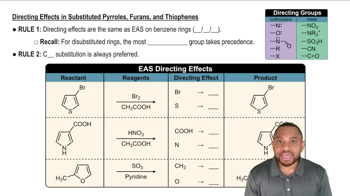
Directing Effects in Substituted Pyrroles, Furans, and Thiophenes Concept 2
관련 실천
교과서 질문

Propose a mechanism for each reaction, showing explicitly how the observed mixtures of products are formed.

(e) 3-chlorobut-1-ene + AgNO3, H2O → but-2-en-1-ol + but-3-en-2-ol

892
views

교과서 질문

Propose a mechanism for each reaction, showing explicitly how the observed mixtures of products are formed.

c. cyclopenta-1,3-diene + Br2 → 3,4-dibromocyclopent-1-ene + 3,5-dibromocyclopent-1-ene

577
views
교과서 질문

Propose a mechanism for each reaction, showing explicitly how the observed mixtures of products are formed.

(b) 2-methylbut-3-en-2-ol + HBr → 1-bromo-3-methylbut-2-ene + 3-bromo-3-methylbut-1-ene

1784
views
교과서 질문

When Br2 is added to buta-1,3-diene at –15 °C, the product mixture contains 60% of product A and 40% of product B. When the same reaction takes place at 60 °C, the product ratio is 10% A and 90% B.

d. If you had a solution of pure A, and its temperature were raised to 60 °C, what would you expect to happen? Propose a mechanism to support your prediction.

758
views
교과서 질문

When N-bromosuccinimide is added to hex-1-ene in CCl4 and a sunlamp is shone on the mixture, three products result.

(a) Give the structures of these three products.

(b) Propose a mechanism that accounts for the formation of these three products

2135
views
교과서 질문

Addition of 1-bromobut-2-ene to magnesium metal in dry ether results in formation of a Grignard reagent. Addition of water to this Grignard reagent gives a mixture of but-1-ene and but-2-ene (cis and trans). When the Grignard reagent is made using 3-bromobut-1-ene, addition of water produces exactly the same mixture of products in the same ratios. Explain this curious result

1009
views