Ch. 17 - Reactions of Aromatic Compounds
Wade - Organic Chemistry 9th Edition
Wade9th EditionOrganic ChemistryISBN: 9780135213728당신이 사용하는 게 아니라요?교과서 변경
17장, 문제 50j

Predict the major products formed when benzene reacts (just once) with the following reagents.
(j) nitric acid + sulfuric acid

검증된 단계별 안내
1
Step 1: Recognize the type of reaction. The reaction of benzene with nitric acid (HNO₃) in the presence of sulfuric acid (H₂SO₄) is an electrophilic aromatic substitution reaction, specifically nitration.
Step 2: Understand the role of the reagents. Sulfuric acid acts as a catalyst and protonates nitric acid, generating the nitronium ion (NO₂⁺), which is the electrophile in this reaction. The reaction can be represented as: HNO_3 + H_2SO_4 → NO_2^+ + HSO_4^- + H_2O.
Step 3: Identify the electrophile and its interaction with benzene. The nitronium ion (NO₂⁺) attacks the π-electron cloud of benzene, forming a resonance-stabilized carbocation intermediate (arenium ion).
Step 4: Regenerate aromaticity. A proton (H⁺) is removed from the carbocation intermediate by the conjugate base (HSO₄⁻), restoring the aromaticity of the benzene ring and forming nitrobenzene as the major product.
Step 5: Summarize the major product. The major product of this reaction is nitrobenzene (C_6H_5NO_2), where a nitro group (-NO₂) is substituted onto the benzene ring.

비슷한 문제에 대한 검증된 영상 답변:

이 영상 해법은 위 문제에 도움이 된다고 튜터들이 추천한 것입니다.
영상 길이:
1m

주요 개념

질문에 올바르게 답하기 위해 반드시 이해해야 하는 핵심 개념들은 다음과 같습니다.

Electrophilic Aromatic Substitution

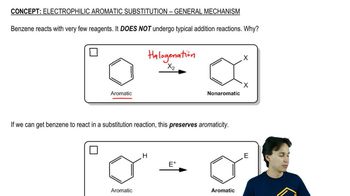
Electrophilic aromatic substitution (EAS) is a fundamental reaction mechanism in organic chemistry where an electrophile replaces a hydrogen atom on an aromatic ring. This process is crucial for understanding how benzene and its derivatives react, as the stability of the aromatic system allows for selective substitution rather than addition.
추천 영상:
03:07
EAS Review

Nitration of Benzene

Nitration is a specific type of electrophilic aromatic substitution where a nitro group (NO2) is introduced into the benzene ring. This reaction typically involves the use of a nitrating mixture, such as nitric acid and sulfuric acid, which generates the nitronium ion (NO2+), the active electrophile that attacks the aromatic ring.
추천 영상:
09:04
Benzene Nomenclature

Regioselectivity in Electrophilic Aromatic Substitution

Regioselectivity refers to the preference of an electrophilic substitution reaction to occur at specific positions on the aromatic ring. In the case of nitration of benzene, the nitro group can be introduced at different positions, but due to the stability of the intermediates formed, the major product is typically the nitrobenzene, with the nitro group being added to the ortho or para positions relative to the original hydrogen.
추천 영상:
03:07
EAS Review