Ch. 17 - Reactions of Aromatic Compounds
Wade - Organic Chemistry 9th Edition
Wade9th EditionOrganic ChemistryISBN: 9780135213728당신이 사용하는 게 아니라요?교과서 변경
17장, 문제 29b

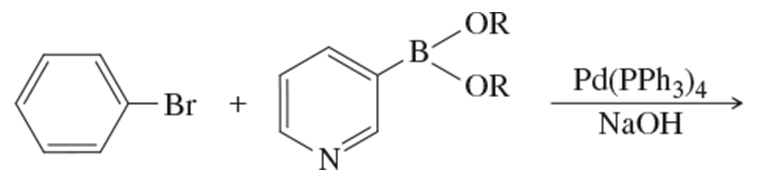
What products would you expect from the following Suzuki coupling reactions?
(b)

검증된 단계별 안내
1
Step 1: Recognize that this is a Suzuki coupling reaction, which involves the cross-coupling of an aryl or vinyl halide (in this case, bromobenzonorbornene) with an organoboron compound (in this case, pyridylboronic ester) in the presence of a palladium catalyst and a base.
Step 2: Identify the two key components: (1) the aryl halide (bromobenzonorbornene) and (2) the organoboron compound (pyridylboronic ester). The palladium catalyst (Pd(PPh₃)₄) facilitates the coupling, and NaOH serves as the base to activate the boronic ester.
Step 3: Understand the mechanism. The reaction proceeds via oxidative addition of the aryl halide to the palladium catalyst, followed by transmetalation with the organoboron compound, and finally reductive elimination to form the new C-C bond.
Step 4: Predict the product. The bromine atom on the bromobenzonorbornene is replaced by the pyridyl group from the boronic ester, resulting in a biaryl product where the pyridyl group is directly bonded to the benzonorbornene ring.
Step 5: Verify the regioselectivity and stereochemistry. Since the reaction involves sp² hybridized carbons, the product will be planar at the site of the new bond. The pyridyl group will attach to the position where the bromine was originally located.

비슷한 문제에 대한 검증된 영상 답변:

이 영상 해법은 위 문제에 도움이 된다고 튜터들이 추천한 것입니다.
영상 길이:
3m

주요 개념

질문에 올바르게 답하기 위해 반드시 이해해야 하는 핵심 개념들은 다음과 같습니다.

Suzuki Coupling Reaction

The Suzuki coupling reaction is a widely used method in organic chemistry for forming carbon-carbon bonds. It involves the reaction of an organoboron compound with a halogenated organic compound in the presence of a palladium catalyst and a base. This reaction is particularly valuable for synthesizing biaryl compounds and is favored for its mild reaction conditions and high functional group tolerance.
추천 영상:
04:02
Suzuki Reaction

Organoboron Compounds

Organoboron compounds, such as boronic acids and boronate esters, are key reactants in Suzuki coupling reactions. They contain a boron atom bonded to a carbon atom, which can participate in nucleophilic attack during the coupling process. The stability and reactivity of these compounds make them essential for forming diverse organic molecules, especially in pharmaceutical and materials chemistry.
추천 영상:
01:40
Defining meso compounds.

Palladium Catalysis

Palladium catalysis is crucial in facilitating the Suzuki coupling reaction. Palladium complexes, often in the form of Pd(0) or Pd(II), serve as catalysts that lower the activation energy required for the reaction to proceed. The palladium catalyst enables the oxidative addition of the halide to the palladium center, followed by transmetalation with the organoboron compound, ultimately leading to the formation of the desired product.
추천 영상:
가이드 코스
2:31
Nucleophilic Catalysis Concept 1