Ch. 18 - Ketones and Aldehydes
Wade - Organic Chemistry 9th Edition
Wade9th EditionOrganic ChemistryISBN: 9780135213728당신이 사용하는 게 아니라요?교과서 변경
18장, 문제 21a

2,4-Dinitrophenylhydrazine is frequently used for making derivatives of ketones and aldehydes because the products (2,4-dinitrophenylhydrazones, called 2,4-DNP derivatives) are even more likely than the phenylhydrazones to be solids with sharp melting points. Propose a mechanism for the reaction of acetone with 2,4-dinitrophenylhydrazine in a mildly acidic solution.

검증된 단계별 안내
1
Step 1: Protonation of the carbonyl group in acetone. In a mildly acidic solution, the carbonyl oxygen of acetone (CH₃COCH₃) is protonated by a hydronium ion (H₃O⁺), increasing the electrophilicity of the carbonyl carbon. This forms a protonated intermediate, CH₃C(OH⁺)CH₃.
Step 2: Nucleophilic attack by 2,4-dinitrophenylhydrazine. The nucleophilic nitrogen atom of the 2,4-dinitrophenylhydrazine (H₂NNH-C₆H₃(NO₂)₂) attacks the electrophilic carbonyl carbon of the protonated acetone, forming a tetrahedral intermediate.
Step 3: Proton transfer to stabilize the intermediate. A proton is transferred from the nitrogen of the hydrazine group to the hydroxyl group of the intermediate, converting the hydroxyl group into a better leaving group (water). This step prepares the intermediate for the elimination step.
Step 4: Elimination of water. The intermediate undergoes elimination of a water molecule, resulting in the formation of a double bond between the carbon and nitrogen atoms. This forms the imine intermediate, specifically the 2,4-dinitrophenylhydrazone derivative.
Step 5: Resonance stabilization of the product. The final product, 2,4-dinitrophenylhydrazone, is stabilized by resonance due to the electron-withdrawing nitro groups on the aromatic ring, which delocalize the lone pair of electrons on the nitrogen atom, contributing to the stability of the product.

비슷한 문제에 대한 검증된 영상 답변:

이 영상 해법은 위 문제에 도움이 된다고 튜터들이 추천한 것입니다.
영상 길이:
8m

주요 개념

질문에 올바르게 답하기 위해 반드시 이해해야 하는 핵심 개념들은 다음과 같습니다.

Nucleophilic Addition

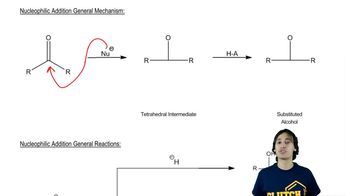
Nucleophilic addition is a fundamental reaction mechanism in organic chemistry where a nucleophile attacks an electrophilic carbon atom, typically in carbonyl compounds like aldehydes and ketones. In this context, the nitrogen atom of 2,4-dinitrophenylhydrazine acts as the nucleophile, attacking the electrophilic carbon of acetone's carbonyl group, leading to the formation of a tetrahedral intermediate.
추천 영상:
08:27
Nucleophilic Addition

Hydrazone Formation

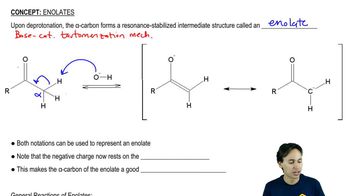
Hydrazone formation is a specific type of condensation reaction where a hydrazine reacts with a carbonyl compound to form a hydrazone. In the case of acetone and 2,4-dinitrophenylhydrazine, the reaction results in the formation of a 2,4-DNP derivative, which is characterized by the loss of water and the formation of a stable C=N bond, contributing to the solid nature of the product.
추천 영상:
02:26
Formation of Enolates

Acid-Base Catalysis

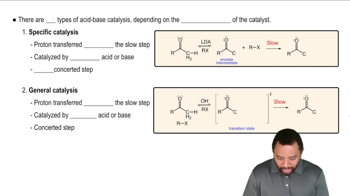
Acid-base catalysis involves the use of an acid to enhance the reactivity of a substrate, often by protonating a functional group to make it a better electrophile. In this reaction, the mildly acidic solution can protonate the carbonyl oxygen of acetone, increasing the electrophilicity of the carbonyl carbon and facilitating the nucleophilic attack by 2,4-dinitrophenylhydrazine.
추천 영상:
가이드 코스
2:50
Acid-Base Catalysis Concept 3