Ch. 18 - Ketones and Aldehydes
Wade - Organic Chemistry 9th Edition
Wade9th EditionOrganic ChemistryISBN: 9780135213728당신이 사용하는 게 아니라요?교과서 변경
18장, 문제 11b

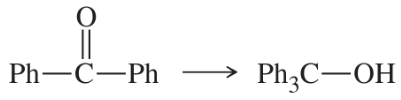
Show how you would accomplish the following synthetic conversions. You may use any additional reagents and solvents you need.
(b)

검증된 단계별 안내
1
Step 1: Analyze the target transformation. The starting material is benzophenone (Ph-C=O-Ph), and the product is triphenylmethanol (Ph3C-OH). This indicates the addition of a phenyl group to the carbonyl carbon and reduction of the carbonyl group to an alcohol.
Step 2: Use a Grignard reagent for the phenyl group addition. Prepare phenylmagnesium bromide (Ph-MgBr) by reacting bromobenzene (Ph-Br) with magnesium in dry ether. This reagent will act as a nucleophile.
Step 3: Perform the nucleophilic addition reaction. React benzophenone with phenylmagnesium bromide in an anhydrous solvent (e.g., diethyl ether). The Grignard reagent will attack the carbonyl carbon, forming a tertiary alkoxide intermediate.
Step 4: Protonate the alkoxide intermediate. Add a dilute acid (e.g., HCl or H2SO4) to the reaction mixture to protonate the alkoxide, converting it into the desired alcohol (triphenylmethanol).
Step 5: Purify the product. Isolate triphenylmethanol by extraction, followed by recrystallization or distillation to ensure purity.

비슷한 문제에 대한 검증된 영상 답변:

이 영상 해법은 위 문제에 도움이 된다고 튜터들이 추천한 것입니다.
영상 길이:
1m

주요 개념

질문에 올바르게 답하기 위해 반드시 이해해야 하는 핵심 개념들은 다음과 같습니다.

Reduction Reactions

Reduction reactions involve the gain of electrons or the addition of hydrogen to a molecule, often resulting in a decrease in oxidation state. In organic chemistry, common reducing agents include lithium aluminum hydride (LiAlH4) and sodium borohydride (NaBH4), which can convert carbonyl compounds, like ketones and aldehydes, into alcohols.
추천 영상:
07:12
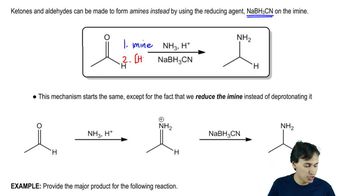
Reductive Amination

Carbonyl Compounds

Carbonyl compounds contain a carbon atom double-bonded to an oxygen atom (C=O). They are classified into aldehydes and ketones based on the carbonyl's position in the molecule. Understanding the reactivity of carbonyls is crucial, as they can undergo various reactions, including reduction to form alcohols, as illustrated in the given conversion.
추천 영상:
01:40
Defining meso compounds.

Nucleophilic Addition

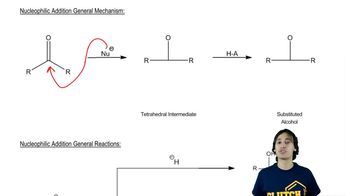
Nucleophilic addition is a fundamental reaction mechanism in organic chemistry where a nucleophile attacks an electrophilic carbon atom, such as the carbon in a carbonyl group. This process is key in the conversion of carbonyl compounds to alcohols, as the nucleophile (often a hydride ion from a reducing agent) adds to the carbonyl carbon, leading to the formation of an alcohol.
추천 영상:
08:27
Nucleophilic Addition