Ch. 19 - Amines
Wade - Organic Chemistry 9th Edition
Wade9th EditionOrganic ChemistryISBN: 9780135213728당신이 사용하는 게 아니라요?교과서 변경
19장, 문제 6b

Rank each set of compounds in order of increasing basicity.
(b) aniline, p-methylaniline, p-nitroaniline

검증된 단계별 안내
1
Step 1: Understand the concept of basicity in organic chemistry. Basicity refers to the ability of a compound to donate a pair of electrons to accept a proton (H⁺). In aromatic amines like aniline and its derivatives, the electron density on the nitrogen atom determines the basicity.
Step 2: Analyze the substituents on the benzene ring for each compound. Substituents can either donate or withdraw electron density through resonance or inductive effects, which affects the electron density on the nitrogen atom. (i) Aniline has no substituents, (ii) p-methylaniline has a methyl group, and (iii) p-nitroaniline has a nitro group.
Step 3: Evaluate the effects of the substituents. The methyl group in p-methylaniline is an electron-donating group via hyperconjugation and inductive effects, increasing the electron density on the nitrogen atom and making it more basic. The nitro group in p-nitroaniline is an electron-withdrawing group via resonance and inductive effects, decreasing the electron density on the nitrogen atom and making it less basic.
Step 4: Rank the compounds based on their basicity. The compound with the highest electron density on the nitrogen atom will be the most basic, and the compound with the lowest electron density will be the least basic. Therefore, p-methylaniline will be the most basic, followed by aniline, and p-nitroaniline will be the least basic.
Step 5: Final ranking in order of increasing basicity: p-nitroaniline < aniline < p-methylaniline.

비슷한 문제에 대한 검증된 영상 답변:

이 영상 해법은 위 문제에 도움이 된다고 튜터들이 추천한 것입니다.
영상 길이:
3m

주요 개념

질문에 올바르게 답하기 위해 반드시 이해해야 하는 핵심 개념들은 다음과 같습니다.

Basicity in Organic Chemistry

Basicity refers to the ability of a compound to accept protons (H+) in a chemical reaction. In organic chemistry, basicity is often influenced by the presence of electron-donating or electron-withdrawing groups attached to a nitrogen atom in amines. The more readily a compound can donate its lone pair of electrons to bond with a proton, the stronger its basicity.
추천 영상:
00:56
What is an organic molecule?

Electron-Donating and Electron-Withdrawing Groups

Electron-donating groups (EDGs) such as alkyl groups increase the electron density on the nitrogen atom, enhancing basicity. Conversely, electron-withdrawing groups (EWGs) like nitro groups decrease electron density, making the nitrogen less basic. Understanding the effects of these groups is crucial for predicting the basicity of substituted amines.
추천 영상:
02:37
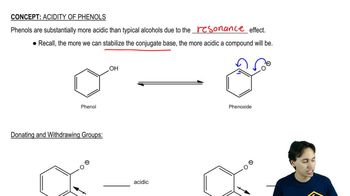
Donating vs Withdrawing Groups

Resonance Effects

Resonance refers to the delocalization of electrons within a molecule, which can stabilize or destabilize certain functional groups. In the case of aniline derivatives, resonance can affect the availability of the nitrogen's lone pair for protonation. For example, in p-nitroaniline, the nitro group withdraws electron density through resonance, reducing the basicity compared to aniline and p-methylaniline.
추천 영상:
03:32
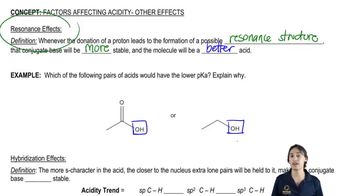
Understanding Resonance Effects