Ch. 21 - Carboxylic Acid Derivatives
Wade - Organic Chemistry 9th Edition
Wade9th EditionOrganic ChemistryISBN: 9780135213728당신이 사용하는 게 아니라요?교과서 변경
21장, 문제 51a

Phosgene is the acid chloride of carbonic acid. Although phosgene was used as a war gas in World War I, it is now used as a reagent for the synthesis of many useful products. Phosgene reacts like other acid chlorides, but it can react twice.

(a) Predict the products formed when phosgene reacts with excess propan-2-ol.

검증된 단계별 안내
1
Step 1: Recognize the structure of phosgene (Cl2C=O), which is an acid chloride derived from carbonic acid. Acid chlorides are reactive electrophiles that undergo nucleophilic acyl substitution reactions.
Step 2: Identify the nucleophile in the reaction. In this case, excess propan-2-ol (CH3CHOHCH3) acts as the nucleophile. Alcohols are good nucleophiles due to the lone pairs on the oxygen atom.
Step 3: Predict the first reaction step. The nucleophilic oxygen of propan-2-ol attacks the carbonyl carbon of phosgene, displacing one chloride ion (Cl-) and forming an intermediate ester-like compound: CH3CHOHCH3-C(=O)-Cl.
Step 4: Predict the second reaction step. Since phosgene can react twice, another molecule of propan-2-ol attacks the remaining carbonyl chloride group in the intermediate, displacing the second chloride ion (Cl-) and forming the final product: CH3CHOHCH3-C(=O)-OCH3CHOHCH3.
Step 5: Summarize the reaction. The final products are a diester (formed by two molecules of propan-2-ol reacting with phosgene) and two chloride ions (Cl-) as byproducts.

비슷한 문제에 대한 검증된 영상 답변:

이 영상 해법은 위 문제에 도움이 된다고 튜터들이 추천한 것입니다.
영상 길이:
3m

주요 개념

질문에 올바르게 답하기 위해 반드시 이해해야 하는 핵심 개념들은 다음과 같습니다.

Nucleophilic Acyl Substitution

Nucleophilic acyl substitution is a fundamental reaction in organic chemistry where a nucleophile attacks the carbonyl carbon of an acyl compound, leading to the replacement of a leaving group. In the case of phosgene, the nucleophile (propan-2-ol) attacks the carbonyl carbon, resulting in the formation of a tetrahedral intermediate that eventually collapses to yield a carboxylic acid derivative and release the leaving group.
추천 영상:
01:47
Nucleophiles and Electrophiles can react in Substitution Reactions.

Acid Chlorides

Acid chlorides are a class of reactive organic compounds characterized by the presence of a carbonyl group (C=O) bonded to a chlorine atom. They are highly reactive due to the electronegative chlorine, which makes the carbonyl carbon more susceptible to nucleophilic attack. Phosgene, as an acid chloride of carbonic acid, exhibits similar reactivity, allowing it to participate in nucleophilic acyl substitution reactions.
추천 영상:
03:13
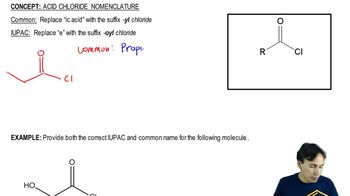
Acid Chloride Nomenclature

Reactivity of Phosgene

Phosgene is notable for its ability to react twice with nucleophiles due to its two reactive acyl chloride groups. This property allows it to form products with two nucleophiles, such as propan-2-ol, leading to the generation of a diester. Understanding this reactivity is crucial for predicting the products of reactions involving phosgene and other similar acid chlorides.
추천 영상:
01:17
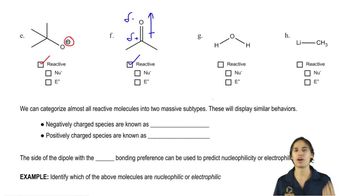
Reactivity of Molecules