Ch. 21 - Carboxylic Acid Derivatives
Wade - Organic Chemistry 9th Edition
Wade9th EditionOrganic ChemistryISBN: 9780135213728당신이 사용하는 게 아니라요?교과서 변경
21장, 문제 11

Propose a mechanism for the reaction of benzyl acetate with methylamine. Label the attacking nucleophile and the leaving group, and draw the transition state in which the leaving group leaves.

검증된 단계별 안내
1
Step 1: Identify the functional groups in benzyl acetate. Benzyl acetate is an ester, which contains a carbonyl group (C=O) bonded to an oxygen atom. Methylamine (CH3NH2) is an amine and acts as a nucleophile due to the lone pair of electrons on the nitrogen atom.
Step 2: Recognize the nucleophilic attack. Methylamine (CH3NH2) will act as the attacking nucleophile, targeting the electrophilic carbon of the carbonyl group in benzyl acetate. The lone pair on the nitrogen of methylamine will attack the carbonyl carbon, forming a tetrahedral intermediate.
Step 3: Label the leaving group. In this reaction, the leaving group is the acetate ion (CH3COO−), which is formed when the bond between the carbonyl carbon and the oxygen of the ester breaks during the reaction.
Step 4: Draw the transition state. The transition state involves partial bonds between the nucleophile (methylamine) and the carbonyl carbon, as well as partial bonds between the carbonyl carbon and the leaving group (acetate ion). This state represents the point of highest energy during the reaction.
Step 5: Complete the mechanism. After the transition state, the tetrahedral intermediate collapses, expelling the acetate ion as the leaving group and forming the final product, which is benzyl methylamide. Ensure to show all curved arrows indicating electron movement throughout the mechanism.

비슷한 문제에 대한 검증된 영상 답변:

이 영상 해법은 위 문제에 도움이 된다고 튜터들이 추천한 것입니다.
영상 길이:
5m

주요 개념

질문에 올바르게 답하기 위해 반드시 이해해야 하는 핵심 개념들은 다음과 같습니다.

Nucleophilic Substitution Mechanism

Nucleophilic substitution is a fundamental reaction in organic chemistry where a nucleophile attacks an electrophile, resulting in the replacement of a leaving group. In the case of benzyl acetate reacting with methylamine, methylamine acts as the nucleophile, attacking the carbon atom bonded to the acetate group. Understanding this mechanism is crucial for predicting the outcome of the reaction and the stability of intermediates.
추천 영상:
01:47
Nucleophiles and Electrophiles can react in Substitution Reactions.

Leaving Groups

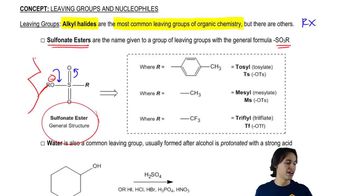
A leaving group is an atom or group that can depart from the parent molecule during a chemical reaction, taking with it the electrons that were shared with the parent. In the reaction of benzyl acetate, the acetate group (-OAc) serves as the leaving group. The ability of a leaving group to stabilize the negative charge after departure is key to the reaction's feasibility and rate.
추천 영상:
07:22
The 3 important leaving groups to know.

Transition State

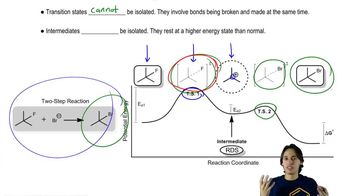
The transition state is a high-energy, unstable arrangement of atoms that occurs during a chemical reaction, representing the point at which reactants are transformed into products. In the context of the reaction between benzyl acetate and methylamine, drawing the transition state involves illustrating the moment when the nucleophile is forming a bond with the carbon atom while the leaving group is departing. This concept is essential for understanding the energy profile and kinetics of the reaction.
추천 영상:
06:55
Intermediates vs. Transition States