Ch. 21 - Carboxylic Acid Derivatives
Wade - Organic Chemistry 9th Edition
Wade9th EditionOrganic ChemistryISBN: 9780135213728당신이 사용하는 게 아니라요?교과서 변경
21장, 문제 8e,f

Show how you would synthesize the following esters from appropriate acyl chlorides and alcohols.
(e) tert-butyl acetate
(f) diallyl succinate

검증된 단계별 안내
1
Identify the esterification reaction: Esters are typically synthesized via a reaction between an acyl chloride and an alcohol in the presence of a base (e.g., pyridine) to neutralize the HCl byproduct.
For tert-butyl acetate: Recognize that the ester is composed of the tert-butyl group (from tert-butyl alcohol) and the acetate group (from acetic acid or its derivative). The acyl chloride needed is acetyl chloride (CH₃COCl), and the alcohol is tert-butyl alcohol ((CH₃)₃COH).
Write the reaction for tert-butyl acetate synthesis: Combine acetyl chloride (CH₃COCl) with tert-butyl alcohol ((CH₃)₃COH) in the presence of a base like pyridine. The reaction proceeds as follows: CH₃COCl + (CH₃)₃COH → CH₃COO(C(CH₃)₃) + HCl.
For diallyl succinate: Recognize that the ester is derived from succinic acid (or its derivative) and allyl alcohol. The acyl chloride needed is succinyl chloride (ClCO(CH₂)₂COCl), and the alcohol is allyl alcohol (CH₂=CHCH₂OH).
Write the reaction for diallyl succinate synthesis: Combine succinyl chloride (ClCO(CH₂)₂COCl) with two equivalents of allyl alcohol (CH₂=CHCH₂OH) in the presence of a base like pyridine. The reaction proceeds as follows: ClCO(CH₂)₂COCl + 2CH₂=CHCH₂OH → (CH₂=CHCH₂OCO(CH₂)₂COOCH₂CH=CH₂) + 2HCl.

비슷한 문제에 대한 검증된 영상 답변:

이 영상 해법은 위 문제에 도움이 된다고 튜터들이 추천한 것입니다.
영상 길이:
3m

주요 개념

질문에 올바르게 답하기 위해 반드시 이해해야 하는 핵심 개념들은 다음과 같습니다.

Acyl Chlorides

Acyl chlorides, also known as acid chlorides, are reactive compounds derived from carboxylic acids by replacing the hydroxyl group (-OH) with a chlorine atom. They are highly reactive and serve as key intermediates in organic synthesis, particularly in the formation of esters and amides. Their reactivity allows them to easily react with alcohols to form esters through nucleophilic acyl substitution.
추천 영상:
01:57
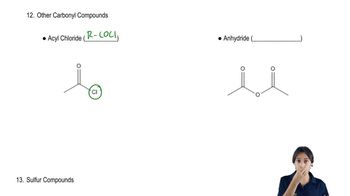
Recognizing acyl chlorides and anhydrides.

Esterification Reaction

Esterification is a chemical reaction that forms an ester from an alcohol and an acid (or acyl chloride). In this process, the hydroxyl group of the acid and a hydrogen atom from the alcohol are eliminated, resulting in the formation of an ester and water. This reaction is typically catalyzed by an acid and is crucial for synthesizing various esters, including those mentioned in the question.
추천 영상:
가이드 코스
1:21
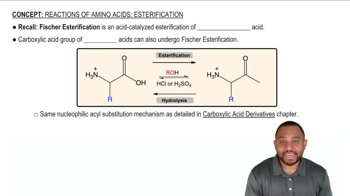
Reactions of Amino Acids: Esterification Concept 1

Synthesis of Diallyl Succinate

Diallyl succinate is a diester formed from succinic acid and allyl alcohol. The synthesis involves the reaction of succinic acid's acyl chloride with two equivalents of allyl alcohol, leading to the formation of the diester. Understanding the structure of succinic acid and the reactivity of allyl alcohol is essential for successfully synthesizing this compound through esterification.
추천 영상:
가이드 코스
1:16
Synthesis of Amino Acids: Strecker Synthesis Example 1