Ch. 23 - Carbohydrates and Nucleic Acids
Wade - Organic Chemistry 9th Edition
Wade9th EditionOrganic ChemistryISBN: 9780135213728당신이 사용하는 게 아니라요?교과서 변경
23장, 문제 47c

Without referring to the chapter, draw the chair conformations of
(c) β-D-galactopyranose (the C4 epimer of glucose).

검증된 단계별 안내
1
Understand the structure of β-D-galactopyranose: It is a six-membered cyclic sugar (pyranose form) with the hydroxyl group at the anomeric carbon (C1) in the beta configuration (equatorial position). Galactose is the C4 epimer of glucose, meaning the configuration of the hydroxyl group at C4 is different from that of glucose.
Draw the basic chair conformation of a six-membered ring: Start by sketching a cyclohexane chair structure. Label the carbon atoms from C1 to C6 in a clockwise direction, with C1 at the top right corner.
Place the substituents on the ring: Add the hydroxyl groups and hydrogen atoms to each carbon based on the stereochemistry of β-D-galactopyranose. For β-D-galactopyranose: (1) At C1, place the hydroxyl group in the equatorial position and the hydrogen in the axial position. (2) At C2, place the hydroxyl group in the equatorial position. (3) At C3, place the hydroxyl group in the axial position. (4) At C4, place the hydroxyl group in the axial position (this is the key difference from glucose). (5) At C5, place the hydroxyl group in the equatorial position. (6) At C6, place the CH2OH group in the equatorial position.
Verify the stereochemistry: Double-check that the substituents match the stereochemistry of β-D-galactopyranose, ensuring that the hydroxyl group at C4 is in the axial position, distinguishing it from glucose.
Finalize the drawing: Clearly label the chair conformation with all substituents, ensuring the beta configuration at C1 and the correct stereochemistry at all other carbons. This will give you the chair conformation of β-D-galactopyranose.

비슷한 문제에 대한 검증된 영상 답변:

이 영상 해법은 위 문제에 도움이 된다고 튜터들이 추천한 것입니다.
영상 길이:
2m

주요 개념

질문에 올바르게 답하기 위해 반드시 이해해야 하는 핵심 개념들은 다음과 같습니다.

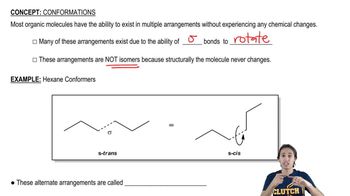
Chair Conformation

The chair conformation is a three-dimensional representation of cyclohexane and its derivatives, which minimizes steric strain and torsional strain. In this conformation, the carbon atoms are arranged in a way that allows for staggered bonds, making it the most stable form of cyclohexane. Understanding chair conformations is crucial for visualizing the spatial arrangement of substituents on cyclic structures, such as sugars.
추천 영상:
03:29
Understanding what a conformer is.

Anomeric Carbon

The anomeric carbon is the carbon atom in a sugar that is derived from the carbonyl carbon during the formation of a cyclic structure. In pyranoses, this carbon is typically the first carbon (C1) and is crucial for determining the alpha or beta configuration of the sugar. The orientation of the hydroxyl group on the anomeric carbon relative to the CH2OH group defines whether the sugar is in the alpha or beta form, which is essential for understanding the properties of carbohydrates.
추천 영상:
02:12
Carbonation of Grignard Reagents

Epimers

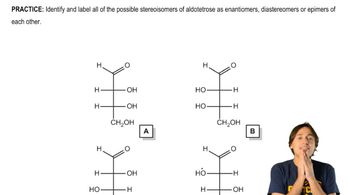
Epimers are a specific type of diastereomer that differ in configuration at only one stereogenic center. In the case of b-D-galactopyranose and glucose, they differ at the C4 position, making them C4 epimers. Recognizing epimers is important in carbohydrate chemistry as it influences the physical and chemical properties of sugars, including their reactivity and biological roles.
추천 영상:
03:42
Identifying Types of Stereoisomers