
Ch.4 - The Study of Chemical Reactions
Wade - Organic Chemistry 9th Edition
Wade9th EditionOrganic ChemistryISBN: 9780135213728당신이 사용하는 게 아니라요?교과서 변경
4장, 문제 8.59

Draw a reaction-energy diagram for the propagation steps of the free-radical addition of HBr to isobutylene. Draw curves representing the reactions leading to both the Markovnikov and the anti-Markovnikov products. Compare the values of ∆Gº and Ea and for the rate-limiting steps, and explain why only one of these products is observed.

검증된 단계별 안내
1
Identify the reactants and products involved in the free-radical addition of HBr to isobutylene. The reactants are isobutylene and HBr, and the products are the Markovnikov and anti-Markovnikov addition products.
Understand the mechanism of free-radical addition. The process involves initiation, propagation, and termination steps. Focus on the propagation steps where the radical intermediates are formed.
Draw the reaction-energy diagram. Start with the energy level of the reactants, then show the energy changes as the reaction proceeds through the formation of radical intermediates to the final products.
For the Markovnikov product, the more stable radical intermediate is formed, leading to a lower activation energy (Ea) and a more negative Gibbs free energy change (∆Gº) for the rate-limiting step.
For the anti-Markovnikov product, the less stable radical intermediate is formed, resulting in a higher activation energy (Ea) and a less favorable Gibbs free energy change (∆Gº). This explains why the Markovnikov product is predominantly observed.

비슷한 문제에 대한 검증된 영상 답변:

이 영상 해법은 위 문제에 도움이 된다고 튜터들이 추천한 것입니다.
영상 길이:
6m

주요 개념

질문에 올바르게 답하기 위해 반드시 이해해야 하는 핵심 개념들은 다음과 같습니다.

Free Radical Mechanism

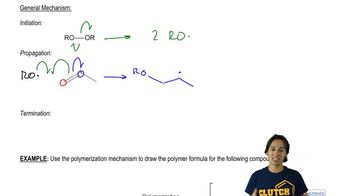
The free radical mechanism involves the formation of reactive species with unpaired electrons, known as free radicals. In the context of the addition of HBr to isobutylene, the reaction proceeds through initiation, propagation, and termination steps. Understanding this mechanism is crucial for analyzing how the radicals interact and lead to different products, specifically the Markovnikov and anti-Markovnikov outcomes.
추천 영상:
03:28
The mechanism of Radical Polymerization.

Markovnikov's Rule

Markovnikov's Rule states that in the addition of HX to an alkene, the hydrogen atom will attach to the carbon with the greater number of hydrogen atoms, leading to the more stable carbocation intermediate. This principle helps predict the major product in reactions involving unsymmetrical alkenes, such as isobutylene, and is essential for understanding the product distribution in the free radical addition of HBr.
추천 영상:
03:54
The 18 and 16 Electron Rule

Activation Energy (Ea) and Gibbs Free Energy (∆Gº)

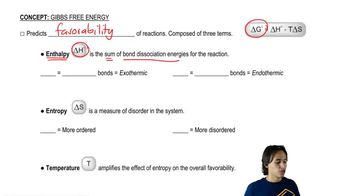
Activation energy (Ea) is the minimum energy required for a reaction to occur, while Gibbs free energy change (∆Gº) indicates the spontaneity of a reaction. In the context of the reaction-energy diagram, comparing the Ea and ∆Gº for the rate-limiting steps of both pathways helps explain why one product is favored over the other. A lower Ea typically correlates with a faster reaction rate, influencing the observed product distribution.
추천 영상:
05:02
Breaking down the different terms of the Gibbs Free Energy equation.