Ch.4 - The Study of Chemical Reactions
Wade - Organic Chemistry 9th Edition
Wade9th EditionOrganic ChemistryISBN: 9780135213728당신이 사용하는 게 아니라요?교과서 변경
4장, 문제 8a

For each reaction, estimate whether ΔS° for the reaction is positive, negative, or impossible to predict.
(a)

검증된 단계별 안내
1
Step 1: Analyze the reaction. The reaction involves the catalytic cracking of n-decane (C₁₀H₂₂) into propene (C₃H₆) and heptane (C₇H₁₆). This process breaks a single large molecule into two smaller molecules.
Step 2: Consider the change in the number of molecules. The reactant is one molecule of n-decane, while the products are two molecules (propene and heptane). An increase in the number of molecules generally leads to an increase in entropy (ΔS° > 0).
Step 3: Evaluate the physical states of the reactants and products. n-Decane is a liquid at standard conditions, while propene is a gas and heptane is a liquid. The formation of a gaseous product (propene) from a liquid reactant contributes to an increase in entropy.
Step 4: Consider molecular complexity. Breaking a larger molecule into smaller fragments typically increases the disorder of the system, further supporting a positive ΔS°.
Step 5: Conclude the estimation. Based on the increase in the number of molecules, the formation of a gaseous product, and the increase in disorder, ΔS° for this reaction is likely positive.

비슷한 문제에 대한 검증된 영상 답변:

이 영상 해법은 위 문제에 도움이 된다고 튜터들이 추천한 것입니다.
영상 길이:
2m

주요 개념

질문에 올바르게 답하기 위해 반드시 이해해야 하는 핵심 개념들은 다음과 같습니다.

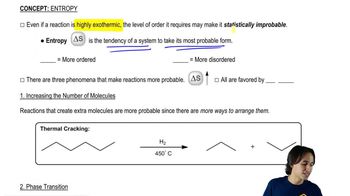
Entropy (ΔS°)

Entropy, represented as ΔS°, is a measure of the disorder or randomness in a system. In chemical reactions, an increase in the number of gas molecules or a transition from a more ordered to a less ordered state typically results in a positive ΔS°, indicating greater disorder. Conversely, a decrease in the number of gas molecules or a transition to a more ordered state results in a negative ΔS°.
추천 영상:
02:46
Explaining what entropy is.

Catalytic Cracking

Catalytic cracking is a process used in the petroleum industry to break down large hydrocarbon molecules into smaller, more valuable products like gasoline and olefins. This reaction typically involves the use of heat and a catalyst, which facilitates the breaking of carbon-carbon bonds, leading to the formation of smaller alkanes and alkenes, such as propene and heptane in the given reaction.
추천 영상:
가이드 코스
3:21
Catalytic Allylic Alkylation Concept 1

Reaction Products and Their States

The products of a reaction can significantly influence the entropy change (ΔS°). In the provided reaction, n-decane (C10H22) is converted into propene (C3H6) and heptane (C7H16). Since the reaction produces a gaseous product (propene) alongside a liquid product (heptane), the overall disorder of the system increases, suggesting a positive ΔS° due to the generation of more gaseous molecules.
추천 영상:
03:08
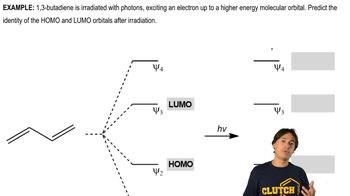
Ground vs. Excited States
관련 실천
교과서 질문

a. Propose a mechanism for the free-radical chlorination of ethane,

1088
views

교과서 질문

When ethene is mixed with hydrogen in the presence of a platinum catalyst, hydrogen adds across the double bond to form ethane. At room temperature, the reaction goes to completion. Predict the signs of ΔH° and ΔS° for this reaction. Explain these signs in terms of bonding and freedom of motion.

3051
views
교과서 질문

Draw a reaction-energy diagram for the propagation steps of the free-radical addition of HBr to isobutylene. Draw curves representing the reactions leading to both the Markovnikov and the anti-Markovnikov products. Compare the values of ∆Gº and Ea and for the rate-limiting steps, and explain why only one of these products is observed.

1173
views
교과서 질문

For each reaction, estimate whether ΔS° for the reaction is positive, negative, or impossible to predict.

(c)

1257
views
교과서 질문

For each reaction, estimate whether ΔS° for the reaction is positive, negative, or impossible to predict.

(b)

1189
views
교과서 질문
The dehydrogenation of butane to trans-but-2-ene has ΔH° = +116 kJ/mol (+27.6 kcal/mol) and ΔS° = +117J/kelvin-mol (+28.0 cal/kelvin-mol). a. Compute the value of ΔG° for dehydrogenation at room temperature (25 °C or 298 °K). Is dehydrogenation favored or disfavored? HINT: When you are doing synthesis problems, avoid using these high-temperature industrial methods. They require specialized equipment, and they produce variable mixtures of products.
1066
views