Ch.4 - The Study of Chemical Reactions
Wade - Organic Chemistry 9th Edition
Wade9th EditionOrganic ChemistryISBN: 9780135213728당신이 사용하는 게 아니라요?교과서 변경
4장, 문제 4

The bromination of methane proceeds through the following steps: 1. Br2 + 2 Br• ΔH° (per mole)/+190 kJ (45 kcal) Ea (per mole)/ 190 kJ (45 kcal) 2. CH4 + Br• —> CH3+ HBr +73 kJ (17 kcal) 79 kJ (19 kcal) 3. • CH3 + Br2 —> CH3Br + Br -112 kJ (-27 kcal) 4 kJ (1 kcal) d. Compute the overall value of ΔH° for the bromination

검증된 단계별 안내
1
Identify the individual steps involved in the bromination of methane and their respective enthalpy changes (\( \Delta H^\circ \)).
Write down the enthalpy change for each step: Step 1: \( \Delta H^\circ = +190 \text{ kJ/mol} \), Step 2: \( \Delta H^\circ = +73 \text{ kJ/mol} \), Step 3: \( \Delta H^\circ = -112 \text{ kJ/mol} \).
To find the overall \( \Delta H^\circ \) for the reaction, sum the enthalpy changes of all the steps: \( \Delta H^\circ_{\text{overall}} = \Delta H^\circ_1 + \Delta H^\circ_2 + \Delta H^\circ_3 \).
Substitute the values from each step into the equation: \( \Delta H^\circ_{\text{overall}} = 190 + 73 - 112 \).
Calculate the sum to determine the overall \( \Delta H^\circ \) for the bromination of methane.

비슷한 문제에 대한 검증된 영상 답변:

이 영상 해법은 위 문제에 도움이 된다고 튜터들이 추천한 것입니다.
영상 길이:
4m

주요 개념

질문에 올바르게 답하기 위해 반드시 이해해야 하는 핵심 개념들은 다음과 같습니다.

Enthalpy Change (ΔH°)

Enthalpy change (ΔH°) is a measure of the heat content of a system at constant pressure. It indicates whether a reaction is exothermic (releases heat, ΔH° < 0) or endothermic (absorbs heat, ΔH° > 0). In the context of the bromination of methane, calculating the overall ΔH° involves summing the enthalpy changes of each step in the reaction mechanism.
추천 영상:
04:38
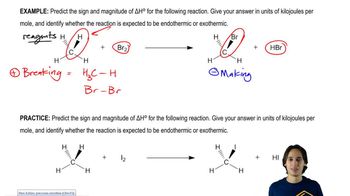
Calculating Enthalpies

Activation Energy (Ea)

Activation energy (Ea) is the minimum energy required for a chemical reaction to occur. It represents the energy barrier that reactants must overcome to form products. In the bromination of methane, understanding Ea helps in analyzing the rate of the reaction and the feasibility of each step, as higher Ea values typically correlate with slower reaction rates.
추천 영상:
가이드 코스
3:22
EAS Reactions of Pyridine Concept 3

Reaction Mechanism

A reaction mechanism is a step-by-step description of the pathway taken by reactants to convert into products. It includes the individual elementary steps, intermediates, and transition states involved in the overall reaction. For the bromination of methane, recognizing the mechanism is crucial for understanding how the enthalpy changes and activation energies of each step contribute to the overall reaction energetics.
추천 영상:
02:16
Heck Reaction Mechanism
관련 실천
교과서 질문

Each of the following proposed mechanisms for the free-radical chlorination of methane is wrong. Explain how the experimental evidence disproves each mechanism.

b.

695
views

교과서 질문
Deuterium (D) is the hydrogen isotope of mass number 2, with a proton and a neutron in its nucleus. The chemistry of deuterium is nearly identical to the chemistry of hydrogen, except that the C―D bond is slightly stronger than the C―H bond by 5.0 kJ/mol (1.2 kcal/ mol). Reaction rates tend to be slower when a C―D bond (as opposed to a C―H bond) is broken in a rate-limiting step. This effect, called a kinetic isotope effect, is clearly seen in the chlorination of methane. Methane undergoes free-radical chlorination 12 times as fast as tetradeuteriomethane (CD4) Faster: CH4 + Cl⋅ —> CH3Cl + HCl relative rate= 12 Slower: CD4 + Cl⋅ —> CD3Cl + DCl relative rate= 1 c. Consider the thermodynamics of the chlorination of methane and the chlorination of ethane, and use the Hammond postulate to explain why one of these reactions has a much larger isotope effect than the other.
1786
views
교과서 질문
The reaction of tert-butyl chloride with methanol (CH3)3C—Cl Tert-butylchloride + CH3—OH methanol —> (CH3)C—OCH3 methyltert-butylether + HCl is found to follow the rate equation rate= Kt[(CH3)3C—Cl] a. What is the kinetic order with respect to tert-butyl chloride?
659
views
교과서 질문
Use bond-dissociation enthalpies [TABLE 4-2], p. 167) to calculate values of ΔH° for the following reactions. a. CH3—CH3 + I2 —> CH3CH2I + HI
1425
views
교과서 질문
The bromination of methane proceeds through the following steps: 1. Br2 + 2 Br• ΔH° (per mole)/+190 kJ (45 kcal) Ea (per mole)/ 190 kJ (45 kcal) 2. CH4 + Br• —> CH3+ HBr +73 kJ (17 kcal) 79 kJ (19 kcal) 3. • CH3 + Br2 —> CH3Br + Br -112 kJ (-27 kcal) 4 kJ (1 kcal) a. Draw a complete reaction-energy diagram for this reaction. b. Label the rate-limiting step.
3508
views
교과서 질문

Each of the following proposed mechanisms for the free-radical chlorination of methane is wrong. Explain how the experimental evidence disproves each mechanism.

a.

1215
views