Ch.4 - The Study of Chemical Reactions
Wade - Organic Chemistry 9th Edition
Wade9th EditionOrganic ChemistryISBN: 9780135213728당신이 사용하는 게 아니라요?교과서 변경
4장, 문제 7

The dehydrogenation of butane to trans-but-2-ene has ΔH° = +116 kJ/mol (+27.6 kcal/mol) and ΔS° = +117J/kelvin-mol (+28.0 cal/kelvin-mol). a. Compute the value of ΔG° for dehydrogenation at room temperature (25 °C or 298 °K). Is dehydrogenation favored or disfavored? HINT: When you are doing synthesis problems, avoid using these high-temperature industrial methods. They require specialized equipment, and they produce variable mixtures of products.

검증된 단계별 안내
1
Identify the given values: ΔH° = +116 kJ/mol and ΔS° = +117 J/K·mol. Convert ΔS° to kJ by dividing by 1000, resulting in ΔS° = +0.117 kJ/K·mol.
Use the Gibbs free energy equation: ΔG° = ΔH° - TΔS°, where T is the temperature in Kelvin.
Substitute the given values into the equation: ΔG° = 116 kJ/mol - (298 K)(0.117 kJ/K·mol).
Calculate the value of TΔS°: (298 K)(0.117 kJ/K·mol).
Subtract the value of TΔS° from ΔH° to find ΔG°. Determine if the reaction is favored by checking if ΔG° is negative (favored) or positive (disfavored).

비슷한 문제에 대한 검증된 영상 답변:

이 영상 해법은 위 문제에 도움이 된다고 튜터들이 추천한 것입니다.
영상 길이:
6m

주요 개념

질문에 올바르게 답하기 위해 반드시 이해해야 하는 핵심 개념들은 다음과 같습니다.

Gibbs Free Energy (ΔG°)

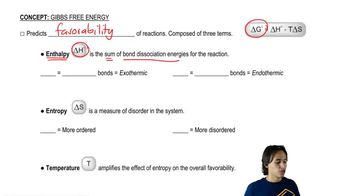
Gibbs Free Energy (ΔG°) is a thermodynamic potential that indicates the spontaneity of a reaction at constant temperature and pressure. It is calculated using the equation ΔG° = ΔH° - TΔS°, where ΔH° is the change in enthalpy, T is the temperature in Kelvin, and ΔS° is the change in entropy. A negative ΔG° value suggests that the reaction is spontaneous, while a positive value indicates non-spontaneity.
추천 영상:
05:02
Breaking down the different terms of the Gibbs Free Energy equation.

Enthalpy (ΔH°)

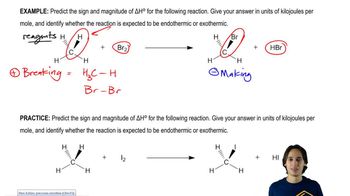
Enthalpy (ΔH°) is a measure of the total heat content of a system and reflects the energy required to break and form bonds during a chemical reaction. In the context of the dehydrogenation of butane, a positive ΔH° value (+116 kJ/mol) indicates that the reaction is endothermic, meaning it absorbs heat from the surroundings. This factor can influence the spontaneity of the reaction when combined with entropy changes.
추천 영상:
04:38
Calculating Enthalpies

Entropy (ΔS°)

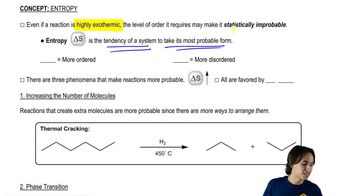
Entropy (ΔS°) is a measure of the disorder or randomness in a system. A positive ΔS° value (+117 J/K·mol) suggests that the products of the reaction have greater disorder compared to the reactants. In thermodynamics, an increase in entropy generally favors spontaneity, as systems tend to evolve towards states of higher disorder. The interplay between ΔH° and ΔS° is crucial for determining the overall spontaneity of a reaction.
추천 영상:
02:46
Explaining what entropy is.
관련 실천
교과서 질문

The following reaction has a value of ΔG° = –2.1 kJ/mol (–0.50 kcal/mol).

CH3Br + H2S ⇌ CH3SH + HBr

b. Starting with a 1 M solution of CH3Br and H2S, calculate the final concentrations of all four species at equilibrium.

1565
views

교과서 질문

When ethene is mixed with hydrogen in the presence of a platinum catalyst, hydrogen adds across the double bond to form ethane. At room temperature, the reaction goes to completion. Predict the signs of ΔH° and ΔS° for this reaction. Explain these signs in terms of bonding and freedom of motion.

3051
views
교과서 질문

Under base-catalyzed conditions, two molecules of acetone can condense to form diacetone alcohol. At room temperature (25 °C), about 5% of the acetone is converted to diacetone alcohol. Determine the value of ΔG° for this reaction.

1269
views
교과서 질문

For each reaction, estimate whether ΔS° for the reaction is positive, negative, or impossible to predict.

(a)

1224
views
교과서 질문

Draw a reaction-energy diagram for the propagation steps of the free-radical addition of HBr to isobutylene. Draw curves representing the reactions leading to both the Markovnikov and the anti-Markovnikov products. Compare the values of ∆Gº and Ea and for the rate-limiting steps, and explain why only one of these products is observed.

1173
views
교과서 질문

The following reaction has a value of ΔG° = –2.1 kJ/mol (–0.50 kcal/mol).

CH3Br + H2S ⇌ CH3SH + HBr

a. Calculate Keq at room temperature (25 °C) for this reaction as written.

1856
views