Ch.5 - Stereochemistry
Wade - Organic Chemistry 9th Edition
Wade9th EditionOrganic ChemistryISBN: 9780135213728당신이 사용하는 게 아니라요?교과서 변경
5장, 문제 5

Which of the following pairs of compounds could be separated by recrystallization or distillation? b. and

검증된 단계별 안내
1
insert step 1
insert step 2
insert step 3
insert step 4
insert step 5

비슷한 문제에 대한 검증된 영상 답변:

이 영상 해법은 위 문제에 도움이 된다고 튜터들이 추천한 것입니다.
영상 길이:
3m

주요 개념

질문에 올바르게 답하기 위해 반드시 이해해야 하는 핵심 개념들은 다음과 같습니다.

Recrystallization

Recrystallization is a purification technique used to separate compounds based on differences in their solubility. When a solid compound is dissolved in a hot solvent and then allowed to cool, pure crystals form as the solubility decreases. Impurities remain in the solution, allowing for the isolation of the desired compound. This method is particularly effective for compounds with similar melting points.

Distillation

Distillation is a separation process that relies on differences in boiling points of compounds. In this technique, a mixture is heated until the component with the lower boiling point vaporizes, then the vapor is cooled and condensed back into a liquid. This method is ideal for separating volatile liquids or for purifying liquids from non-volatile impurities, making it a common technique in organic chemistry.

Polarity and Solubility

Polarity refers to the distribution of electrical charge over the atoms in a molecule, influencing its solubility in various solvents. Compounds with similar polarities tend to dissolve well in each other, while those with differing polarities may not. Understanding the polarity of the compounds in question is crucial for determining the appropriate method of separation, as it affects both recrystallization and distillation outcomes.
추천 영상:
07:13
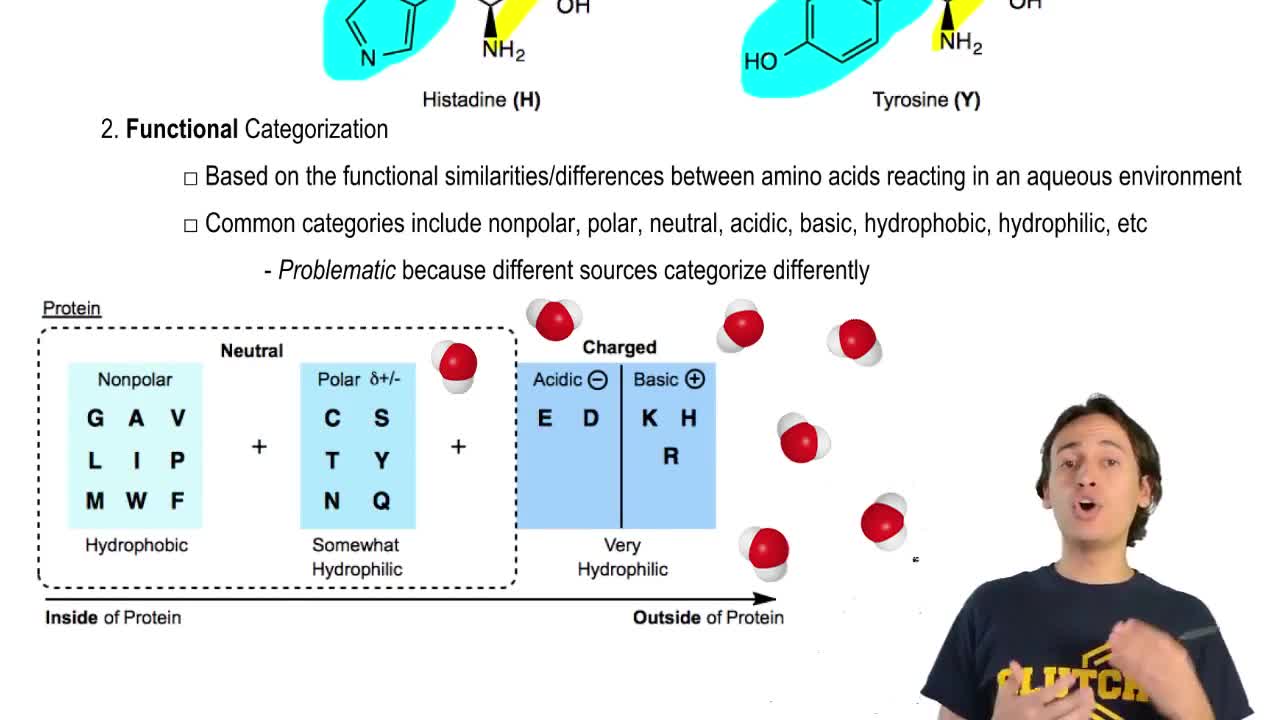
Functional Classification
관련 실천
교과서 질문
To show that (R)-2-butyl (R,R)-tartrate and (S)-2-butyl (R,R)-tartrate are not enantiomers, draw and name the mirror images of these compounds.
1038
views

교과서 질문
For each of the compounds described by the following names, 1. draw a three-dimensional representation. 2. star (*) each chiral center. 3. draw any planes of symmetry. 4. draw any enantiomer. 5. draw any diastereomers. 6. label each structure you have drawn as chiral or achiral. c. (2R,3S)-2,3-dibromohexane d. (1R,2R)-1,2-dibromocyclohexane
1695
views
교과서 질문

For each compound, determine whether the molecule has an internal mirror plane of symmetry. If it does, draw the mirror plane on a three-dimensional drawing of the molecule. If the molecule does not have an internal mirror plane, determine whether the structure is chiral.

(a) methane

(b) cis-1,2-dibromocyclobutane

(c) trans-1,2-dibromocyclobutane

1151
views
교과서 질문

For each compound, determine whether the molecule has an internal mirror plane of symmetry. If it does, draw the mirror plane on a three-dimensional drawing of the molecule. If the molecule does not have an internal mirror plane, determine whether the structure is chiral.

(d) 1,2-dichloropropane

(e)

1828
views
교과서 질문
For each compound, determine whether the molecule has an internal mirror plane of symmetry. If it does, draw the mirror plane on a three-dimensional drawing of the molecule. If the molecule does not have an internal mirror plane, determine whether the structure is chiral. a. Methane b. cis-1,2-dibromocyclobutane c. trans-1,2-dibromocyclobutane
1539
views
교과서 질문

For each compound, determine whether the molecule has an internal mirror plane of symmetry. If it does, draw the mirror plane on a three-dimensional drawing of the molecule. If the molecule does not have an internal mirror plane, determine whether the structure is chiral.

(h)

862
views