
Ch.8 - Reactions of Alkenes
Wade - Organic Chemistry 9th Edition
Wade9th EditionOrganic ChemistryISBN: 9780135213728당신이 사용하는 게 아니라요?교과서 변경
8장, 문제 54a,b

Professor Patrick Dussault (University of Nebraska at Lincoln) has developed an alternative to the standard two-step ozonolysis procedure requiring reduction of the ozonide in a second step. He uses 2 to 3 equivalents of pyridine, a mildly basic organic solvent, in a one-step process (Organic Letters, 2012, 14, 2242). Show the products you expect from the following examples.
(a) Chemical reaction diagram showing ozonolysis with ozone and pyridine at -78°C, indicating a 93% yield of products.
(b) Chemical reaction diagram showing ozonolysis of t-butyl compound with pyridine, yielding products at -78°C with 85% yield.

검증된 단계별 안내
1
Step 1: Understand the reaction conditions. The reaction involves ozonolysis using ozone (O₃) in the presence of pyridine at -78°C. This is a one-step process where pyridine acts as a mild base to stabilize intermediates and avoid the formation of explosive ozonides.
Step 2: Recall the mechanism of ozonolysis. Ozone reacts with the double bond in the alkene to form a molozonide intermediate, which rearranges to a more stable ozonide. In the presence of pyridine, the ozonide is directly decomposed into carbonyl compounds (aldehydes or ketones).
Step 3: Analyze the structure of the starting material. For example (a), the starting material is a cyclohexene derivative with a methyl group attached to the ring. The double bond will be cleaved, and the resulting fragments will form carbonyl compounds. For example (b), the starting material is a cyclohexene derivative with a tert-butyl group attached to the ring. The double bond will also be cleaved, yielding carbonyl compounds.
Step 4: Predict the products. In ozonolysis, the cleavage of the double bond results in two fragments. Each fragment will have a carbonyl group (C=O) at the site of cleavage. For example (a), the cleavage of the double bond in cyclohexene will yield two carbonyl compounds: one from the ring and one from the methyl group. For example (b), the cleavage will yield two carbonyl compounds: one from the ring and one from the tert-butyl group.
Step 5: Verify the yield and reaction efficiency. The reaction yields are given as 93% for example (a) and 85% for example (b), indicating high efficiency. Ensure the predicted products align with the expected carbonyl compounds based on the structure of the starting materials.

비슷한 문제에 대한 검증된 영상 답변:

이 영상 해법은 위 문제에 도움이 된다고 튜터들이 추천한 것입니다.
영상 길이:
1m

주요 개념

질문에 올바르게 답하기 위해 반드시 이해해야 하는 핵심 개념들은 다음과 같습니다.

Ozonolysis

Ozonolysis is a chemical reaction involving the cleavage of alkenes or alkynes using ozone (O3) to form carbonyl compounds, such as aldehydes and ketones. This reaction typically occurs in two steps: the formation of an ozonide intermediate followed by reduction. However, in the context of this question, a one-step ozonolysis using pyridine as a solvent simplifies the process, allowing for direct product formation without the need for a separate reduction step.
추천 영상:
06:30
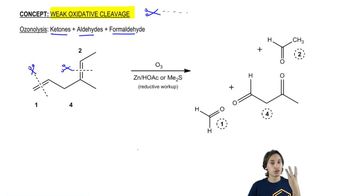
General properties of ozonolysis.

Role of Pyridine

Pyridine is a basic organic solvent that can stabilize the ozonide intermediate formed during ozonolysis. Its basicity helps to facilitate the reaction by promoting the cleavage of the ozonide, leading to the formation of carbonyl products. In this one-step ozonolysis process, pyridine not only acts as a solvent but also plays a crucial role in the reaction mechanism, enhancing the yield of the desired products.
추천 영상:
가이드 코스
1:07
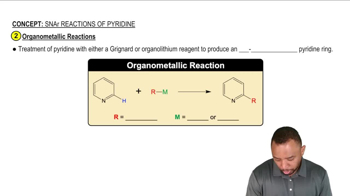
SNAr Reactions of Pyridine Concept 2

Reaction Conditions

The reaction conditions, including temperature and concentration of reagents, significantly influence the outcome of ozonolysis. In this case, the reaction is conducted at -78°C, which helps to control the reaction rate and minimize side reactions. Maintaining low temperatures is essential for achieving high yields, as it stabilizes the intermediates and products, allowing for a more selective reaction pathway.
추천 영상:
가이드 코스
1:18
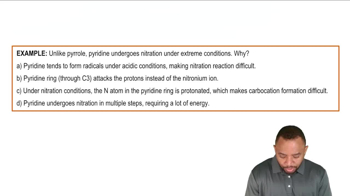
EAS Reactions of Pyridine Example 1