Ch.6 - Alkyl Halides; Nucleophilic Substitution
Wade - Organic Chemistry 9th Edition
Wade9th EditionOrganic ChemistryISBN: 9780135213728당신이 사용하는 게 아니라요?교과서 변경
6장, 문제 37a

When ethyl bromide is added to potassium tert-butoxide, the product is ethyl tert-butyl ether.
CH3CH2–Br + (CH3)3C–O–K+ → (CH3)3C–O–CH2CH3 ethyl bromide potassium tert-butoxide ethyl tert-butyl ether
a. What happens to the reaction rate if the concentration of ethyl bromide is doubled?

검증된 단계별 안내
1
Step 1: Recognize that this reaction is an example of a Williamson ether synthesis, which proceeds via an SN2 (bimolecular nucleophilic substitution) mechanism.
Step 2: Recall that the rate of an SN2 reaction depends on the concentrations of both the nucleophile (potassium tert-butoxide) and the electrophile (ethyl bromide). The rate law for an SN2 reaction is: r = k⋅[RBr⋅[Nu, where RBr is the alkyl halide (ethyl bromide) and Nu is the nucleophile (tert-butoxide).
Step 3: Analyze the effect of doubling the concentration of ethyl bromide. Since the rate law is directly proportional to the concentration of ethyl bromide, doubling its concentration will double the reaction rate, assuming the concentration of potassium tert-butoxide remains constant.
Step 4: Understand that this proportional relationship is a hallmark of the SN2 mechanism, where the reaction rate depends on the simultaneous interaction of the nucleophile and the electrophile in the rate-determining step.
Step 5: Conclude that if the concentration of ethyl bromide is doubled, the reaction rate will also double, as per the rate law for an SN2 reaction.

비슷한 문제에 대한 검증된 영상 답변:

이 영상 해법은 위 문제에 도움이 된다고 튜터들이 추천한 것입니다.

주요 개념

질문에 올바르게 답하기 위해 반드시 이해해야 하는 핵심 개념들은 다음과 같습니다.

Reaction Rate

The reaction rate refers to the speed at which reactants are converted into products in a chemical reaction. It is influenced by factors such as concentration, temperature, and the presence of catalysts. In this context, understanding how the concentration of ethyl bromide affects the reaction rate is crucial for predicting the outcome of the reaction.
추천 영상:
가이드 코스
5:07
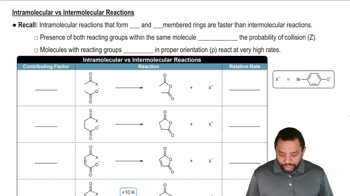
Rates of Intramolecular Reactions Concept 2

Concentration and Rate Law

The rate law expresses the relationship between the concentration of reactants and the rate of the reaction. For a reaction involving ethyl bromide, if the rate law indicates a first-order dependence on its concentration, doubling the concentration would double the reaction rate. This concept is essential for analyzing how changes in reactant concentrations impact the overall reaction kinetics.
추천 영상:
가이드 코스
2:36
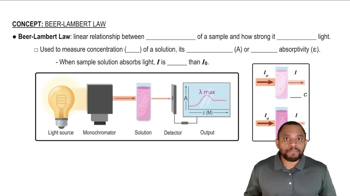
The Beer-Lambert Law Concept 1

Nucleophilic Substitution Mechanism

The reaction between ethyl bromide and potassium tert-butoxide involves a nucleophilic substitution mechanism, where the nucleophile (tert-butoxide) attacks the electrophilic carbon in ethyl bromide. Understanding this mechanism helps in predicting how the reaction proceeds and how the concentration of reactants influences the rate of product formation.
추천 영상:
01:47
Nucleophiles and Electrophiles can react in Substitution Reactions.