Skip to main content
Personal Health
나의 코스
배우기
시험 준비
AI 튜터
학습 가이드
플래시카드
앱을 사용해 보세요
나의 코스
배우기
시험 준비
AI 튜터
학습 가이드
플래시카드
앱을 사용해 보세요
뒤로
Modes of Transmission quiz
카드를 뒤집기 위해 탭할 수 있습니다.
What are the two main modes of transmission for infections?
카드를 뒤집기 위해 탭할 수 있습니다.
👆
What are the two main modes of transmission for infections?
The two main modes are direct transmission and indirect transmission.
진행 상황 추적
컨트롤 버튼이 '내비게이션' 모드로 변경되었습니다.
1/20
관련 플래시카드
관련 실천
추천 영상
Modes of Transmission definitions
Modes of Transmission
14 용어
Modes of Transmission quiz #1
Modes of Transmission
10 용어
Modes of Transmission
Ch.11 Infectious Diseases
2 문제점
주제
Ally
Infection Risk Factors
Ch.11 Infectious Diseases
4 문제점
주제
Laura
Ch.11 Infectious Diseases - Part 1 of 3
4 주제
4 문제점
장
Nicole
Ch.11 Infectious Diseases - Part 2 of 3
4 주제
8 문제점
장
Ally
Ch.11 Infectious Diseases - Part 3 of 3
3 주제
7 문제점
장
Nicole
VideoThumbView.guidedCourse
1:43
Modes of Transmission Concept 2
32
views
VideoThumbView.guidedCourse
3:12
Modes of Transmission Concept 1
47
views
VideoThumbView.guidedCourse
1:32
Modes of Transmission Example 1
36
views
이 집합의 용어 (20)
하이드의 정의
What are the two main modes of transmission for infections?
The two main modes are direct transmission and indirect transmission.
How does direct transmission occur?
Direct transmission occurs through physical contact between hosts, such as handshakes or hugs.
What is indirect transmission?
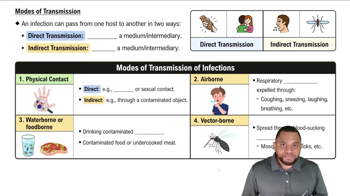
Indirect transmission involves a medium or intermediary, such as contaminated objects, airborne droplets, or vectors.
Give an example of direct transmission.
Examples include handshakes, hugs, or sexual contact.
How can contaminated objects lead to infection?
Touching objects like doorknobs or phones contaminated with infectious agents can result in indirect transmission.
What role do respiratory droplets play in transmission?
Respiratory droplets expelled by coughing, sneezing, or breathing can carry infectious agents to new hosts via airborne indirect transmission.
Name a disease transmitted by mosquitoes.
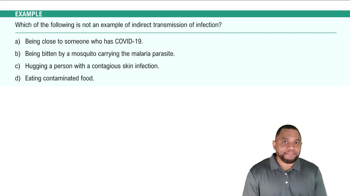
Malaria is transmitted by mosquitoes through vectorborne indirect transmission.
What is vectorborne transmission?
Vectorborne transmission is when blood-sucking insects like mosquitoes, fleas, or ticks spread infections between hosts.
How can food and water contribute to indirect transmission?
Consuming contaminated water or undercooked food can lead to waterborne or foodborne infections.
What is a zoonotic infection?
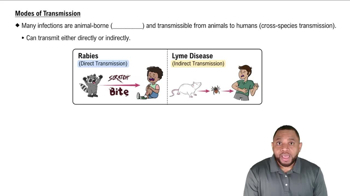
A zoonotic infection is an animal-borne disease that can be transmitted from animals to humans.
How is rabies transmitted from animals to humans?
Rabies is transmitted directly through bites or scratches from infected animals.
Describe how Lyme disease is transmitted.
Lyme disease is transmitted indirectly via ticks that act as vectors, passing the infection from animals like mice or deer to humans.
Why is it important to check for ticks after being in the woods?
Ticks can transmit Lyme disease, so checking for them helps prevent infection.
Can zoonotic infections be transmitted both directly and indirectly?
Yes, zoonotic infections can be transmitted through both direct and indirect routes.
What is the role of hygiene in preventing infections?
Good hygiene helps reduce the risk of both direct and indirect transmission of infections.
Why is vector control important in public health?
Vector control reduces the spread of diseases transmitted by insects like mosquitoes and ticks.
What is the significance of understanding transmission pathways?
Understanding transmission pathways is crucial for preventing infections and managing public health risks.
How can respiratory droplets serve as a port of exit for infectious agents?
Respiratory droplets expelled from the body can carry infectious agents to new hosts, facilitating airborne transmission.
What is an example of indirect transmission involving a contaminated object?
Touching a doorknob or remote control contaminated with infectious agents is an example of indirect transmission.
What should you do to reduce your risk of zoonotic infections after outdoor activities?
Check yourself for ticks and be aware of animal contact to reduce the risk of zoonotic infections.
 뒤로뒤로
뒤로뒤로


 1:43
1:43