Skip to main content
Personal Health
나의 코스
배우기
시험 준비
AI 튜터
학습 가이드
플래시카드
앱을 사용해 보세요
나의 코스
배우기
시험 준비
AI 튜터
학습 가이드
플래시카드
앱을 사용해 보세요
뒤로
Principles of Physical Training quiz
카드를 뒤집기 위해 탭할 수 있습니다.
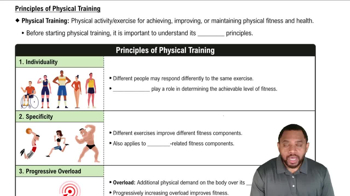
What is the principle of individuality in physical training?
카드를 뒤집기 위해 탭할 수 있습니다.
👆
What is the principle of individuality in physical training?
Individuality means that people respond differently to the same exercise due to genetic factors, which influence their achievable fitness levels.
진행 상황 추적
컨트롤 버튼이 '내비게이션' 모드로 변경되었습니다.
1/20
관련 플래시카드
관련 실천
추천 영상
Principles of Physical Training definitions
Principles of Physical Training
15 용어
Principles of Physical Training quiz #1
Principles of Physical Training
34 용어
Principles of Physical Training
Ch.7 Exercise and Fitness
5 문제점
주제
Ally
Exercise Program
Ch.7 Exercise and Fitness
5 문제점
주제
Brendan
Ch.7 Exercise and Fitness
4 주제
12 문제점
장
Laura
VideoThumbView.guidedCourse
3:16
The FITT Principle Concept 2
108
views
VideoThumbView.guidedCourse
5:21
Physical Training Concept 1
100
views
VideoThumbView.guidedCourse
2:02
The FITT Principle Example 2
66
views
이 집합의 용어 (20)
하이드의 정의
What is the principle of individuality in physical training?
Individuality means that people respond differently to the same exercise due to genetic factors, which influence their achievable fitness levels.
How can continuous exercise affect muscle oxygen intake?
Continuous and rigorous exercise can improve muscle oxygen intake efficiency by about 5 to 30%.
Why do athletes in different sports often have different body shapes and sizes?
Athletes' body shapes and sizes are often suited to the specific demands of their sport, reflecting the principle of individuality.
What does the principle of specificity state?
Specificity means that different exercises improve different fitness components and skill-related abilities.
Why might a bodybuilder's training not improve cardiorespiratory fitness?
Bodybuilders focus on weight-bearing exercises for muscle mass, which may not benefit cardiorespiratory fitness or other components like agility.
What is progressive overload in physical training?
Progressive overload involves gradually increasing physical demands on the body to improve fitness.
What can happen if overload is increased too quickly?
Increasing overload too quickly can be ineffective or cause injury.
How did the football coach in the example apply progressive overload?
The coach increased the weight lifted in each set by five pounds, progressively challenging the muscles.
What is the principle of reversibility?
Reversibility means that fitness gains can be lost if training stops, with up to half lost within two months of inactivity.
How quickly can fitness gains diminish after stopping exercise?
An individual can lose half of their fitness gains within two months of stopping exercise.
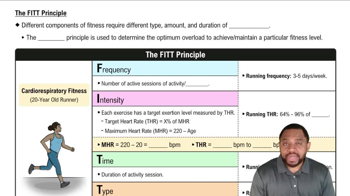
What does the FITT principle stand for?
FITT stands for Frequency, Intensity, Time, and Type.
What does 'frequency' refer to in the FITT principle?
Frequency is the number of active sessions of activity per week.
How is 'intensity' measured in the FITT principle?
Intensity is measured by the target exertion level, often using target heart rate (THR).
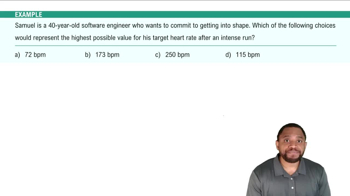
How do you calculate maximum heart rate (MHR)?
Maximum heart rate is calculated as 220 minus your age.
What is the target heart rate (THR) range for aerobic exercise?
THR is typically 64% to 96% of your maximum heart rate.
If a runner is 20 years old, what is her maximum heart rate?
Her maximum heart rate would be 220 minus 20, which equals 200 beats per minute.
How do you calculate the THR for a 20-year-old runner?
Multiply the MHR (200) by 0.64 and 0.96 to get a THR range of 128 to 192 beats per minute.
What does 'time' refer to in the FITT principle?
Time refers to the duration of each activity session, such as 20 to 60 minutes per session.
What does 'type' refer to in the FITT principle?
Type focuses on the particular health-related fitness component targeted, such as running for cardiorespiratory fitness.
Why is regular training important for maintaining fitness gains?
Regular training is crucial because fitness gains can diminish rapidly with inactivity, following the principle of reversibility.
 뒤로뒤로
뒤로뒤로


 3:16
3:16