Skip to main content
Physics with Calculus
나의 코스
배우기
시험 준비
AI 튜터
학습 가이드
교과서적 해결책
플래시카드
탐험해 보세요
앱을 사용해 보세요
나의 코스
배우기
시험 준비
AI 튜터
학습 가이드
교과서적 해결책
플래시카드
탐험해 보세요
앱을 사용해 보세요
뒤로
Systems of Objects with Friction quiz
카드를 뒤집기 위해 탭할 수 있습니다.
What must you consider for each object in a system of connected objects with friction?
카드를 뒤집기 위해 탭할 수 있습니다.
👆
What must you consider for each object in a system of connected objects with friction?
You must consider the friction acting on each individual object in the system.
진행 상황 추적
컨트롤 버튼이 '내비게이션' 모드로 변경되었습니다.
1/15
관련 플래시카드
관련 실천
추천 영상
Systems of Objects with Friction definitions
Systems of Objects with Friction
15 용어
Systems of Objects with Friction
7. Friction, Inclines, Systems
6 문제점
주제
Patrick
Systems of Objects on Inclined Planes with Friction
7. Friction, Inclines, Systems
3 문제점
주제
Patrick
7. Friction, Inclines, Systems - Part 1 of 2
4 주제
11 문제점
장
Patrick
7. Friction, Inclines, Systems - Part 2 of 2
4 주제
10 문제점
장
Patrick
VideoThumbView.guidedCourse
06:21
Connected Objects With Friction
8352
views
158
rank
4
comments
이 집합의 용어 (15)
하이드의 정의
What must you consider for each object in a system of connected objects with friction?
You must consider the friction acting on each individual object in the system.
What is the first step when solving problems involving systems of objects with friction?
The first step is to draw free body diagrams for each object in the system.
What type of friction is present when objects are already moving?
Kinetic friction is present when objects are already moving.
How do you calculate the kinetic friction force acting on an object?
Kinetic friction force is calculated as the coefficient of kinetic friction times the normal force (f_k = μ_k * N).
What is the relationship between the acceleration of connected objects in a system?
Connected objects always have the same acceleration and velocity.
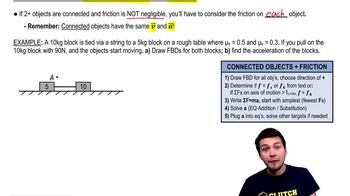
In the example, what is the applied force acting on the 10 kg block?
The applied force acting on the 10 kg block is 90 N.
What forces are shown in the free body diagram of each block?
The free body diagram includes tension, normal force, gravitational force, and frictional force for each block.
How do you determine the direction of positive acceleration in these problems?
You assume the direction in which the blocks are being pulled (usually to the right) as positive.
What equation is used to relate the forces and acceleration for each block?
Newton's second law, F = ma, is used for each block.
How do you express the friction force in terms of known quantities for each block?
Friction force is expressed as μ_k times the block's mass times gravity (μ_k * m * g).
Why do you need to set up equations for both blocks in the system?
You need equations for both blocks because tension is unknown and must be eliminated to solve for acceleration.
How do you eliminate the tension force from the system of equations?
You add the two equations for each block so that the tension terms cancel out.
What is the final calculated acceleration of the system in the example?
The final calculated acceleration of the system is 3.06 m/s².
What is the normal force acting on a block sliding horizontally?
The normal force equals the gravitational force on the block (N = mg) if the block is sliding horizontally.
What is the purpose of drawing free body diagrams for each object in the system?
Free body diagrams help identify all the forces acting on each object, which is essential for setting up the correct equations.
 뒤로뒤로
뒤로뒤로
 06:21
06:21