Skip to main content
Physics with Calculus
나의 코스
배우기
시험 준비
AI 튜터
학습 가이드
교과서적 해결책
플래시카드
탐험해 보세요
앱을 사용해 보세요
나의 코스
배우기
시험 준비
AI 튜터
학습 가이드
교과서적 해결책
플래시카드
탐험해 보세요
앱을 사용해 보세요
뒤로
Beam / Shelf Against a Wall quiz
카드를 뒤집기 위해 탭할 수 있습니다.
What are the main forces acting on a beam held against a wall by a cable in static equilibrium?
카드를 뒤집기 위해 탭할 수 있습니다.
👆
What are the main forces acting on a beam held against a wall by a cable in static equilibrium?
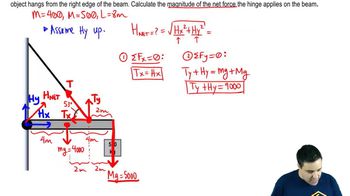
The main forces are the weight of the beam (mg), the tension in the cable (T, decomposed into Tx and Ty), and the hinge forces (Hx and Hy).
진행 상황 추적
컨트롤 버튼이 '내비게이션' 모드로 변경되었습니다.
1/15
관련 플래시카드
관련 실천
추천 영상
Beam / Shelf Against a Wall definitions
Beam / Shelf Against a Wall
15 용어
Beam / Shelf Against a Wall
15. Rotational Equilibrium
6 문제점
주제
Patrick
More 2D Equilibrium Problems
15. Rotational Equilibrium
3 문제점
주제
Patrick
15. Rotational Equilibrium - Part 1 of 2
4 주제
9 문제점
장
Patrick
15. Rotational Equilibrium - Part 2 of 2
4 주제
12 문제점
장
Patrick
VideoThumbView.guidedCourse
13:40
Beam supporting an object
2708
views
12
rank
10
comments
VideoThumbView.guidedCourse
17:08
Beam / Shelf Against a Wall
4584
views
29
rank
7
comments
이 집합의 용어 (15)
하이드의 정의
What are the main forces acting on a beam held against a wall by a cable in static equilibrium?
The main forces are the weight of the beam (mg), the tension in the cable (T, decomposed into Tx and Ty), and the hinge forces (Hx and Hy).
Why do we decompose the tension in the cable into Tx and Ty components?
We decompose the tension to analyze the equilibrium conditions separately along the x and y axes.
What is the purpose of the hinge force Hx in these problems?
Hx balances the horizontal component of the tension (Tx) to maintain equilibrium in the x-direction.
What does it mean if you calculate a negative value for Hy?
A negative Hy means the actual direction of the hinge's vertical force is downward, not upward as initially assumed.
Why is a vertical hinge force (Hy) necessary even if Ty and mg are present?
Hy is needed because Ty acts farther from the hinge than mg, so their torques would not balance without Hy.
How do you set up the equilibrium equations for forces in this scenario?
Set the sum of forces in the x-direction to zero (Hx = Tx) and the sum in the y-direction to zero (Ty + Hy = mg).
What is the best point to take torques about when solving for the tension in the cable?
The best point is the hinge, as it eliminates the torques from Hx and Hy, simplifying calculations.
Which forces do not produce torque about the hinge and why?
Hx and Hy do not produce torque about the hinge because their lines of action pass through the hinge.
How do you calculate the torque produced by the weight of the beam (mg)?
The torque is mg times the perpendicular distance from the hinge to the beam's center of mass.
In the example, what is the value of Ty relative to mg and why?
Ty is half of mg (Ty = mg/2) because it acts at twice the distance from the hinge compared to mg, balancing the torques.
How do you find the total tension T in the cable once Ty is known?
Use T = Ty / sin(theta), where theta is the angle the cable makes with the horizontal.
How do you calculate the horizontal hinge force Hx?
Hx equals Tx, which is T cos(theta), using the previously found value of T.
How do you determine the vertical hinge force Hy?
Hy is found by subtracting Ty from mg: Hy = mg - Ty.
How do you calculate the net force applied by the hinge (Hnet)?
Hnet is the square root of the sum of the squares of Hx and Hy: Hnet = sqrt(Hx^2 + Hy^2).
What symmetry is observed in the base case of this beam problem?
In the base case, Ty equals Hy, Tx equals Hx, and the magnitudes and angles of T and H are the same.
 뒤로
뒤로
 13:40
13:40