Skip to main content
Physics with Calculus
나의 코스
배우기
시험 준비
AI 튜터
학습 가이드
교과서적 해결책
플래시카드
탐험해 보세요
앱을 사용해 보세요
나의 코스
배우기
시험 준비
AI 튜터
학습 가이드
교과서적 해결책
플래시카드
탐험해 보세요
앱을 사용해 보세요
뒤로
Conservation of Energy in Rolling Motion quiz
카드를 뒤집기 위해 탭할 수 있습니다.
What two types of motion are involved in rolling motion?
카드를 뒤집기 위해 탭할 수 있습니다.
👆
What two types of motion are involved in rolling motion?
Rolling motion involves both rotation around an axis and translation along a surface.
진행 상황 추적
컨트롤 버튼이 '내비게이션' 모드로 변경되었습니다.
1/15
관련 플래시카드
관련 실천
추천 영상
Conservation of Energy in Rolling Motion definitions
Conservation of Energy in Rolling Motion
15 용어
Conservation of Energy in Rolling Motion
13. Rotational Inertia & Energy
8 문제점
주제
Patrick
Parallel Axis Theorem
13. Rotational Inertia & Energy
5 문제점
주제
Patrick
13. Rotational Inertia & Energy - Part 1 of 2
5 주제
11 문제점
장
David-Paige
13. Rotational Inertia & Energy - Part 2 of 2
7 주제
12 문제점
장
David-Paige
VideoThumbView.guidedCourse
15:27
Sphere on rough and smooth hills
3666
views
29
rank
3
comments
VideoThumbView.guidedCourse
12:26
Conservation of Energy in Rolling Motion
5125
views
37
rank
2
comments
이 집합의 용어 (15)
하이드의 정의
What two types of motion are involved in rolling motion?
Rolling motion involves both rotation around an axis and translation along a surface.
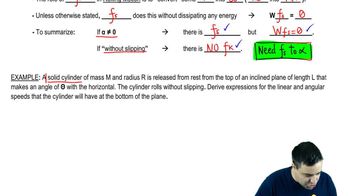
What is the role of static friction in rolling motion?
Static friction enables rolling by converting some linear velocity into angular velocity without dissipating energy.
Does static friction do any work in rolling motion without slipping?
No, the work done by static friction is zero in rolling motion without slipping.
What does 'rolling without slipping' imply about the types of friction present?
It means static friction is present but kinetic friction is absent.
What is the relationship between linear velocity (v) and angular velocity (omega) in rolling motion?
The relationship is v = r * omega, where r is the radius of the object.
What is the moment of inertia (I) for a solid cylinder?
For a solid cylinder, I = (1/2) M R^2, where M is mass and R is radius.
How is conservation of energy applied in rolling motion problems?
Both translational and rotational kinetic energies, as well as potential energy, are considered, with total mechanical energy conserved.
What types of kinetic energy does a rolling object have at the bottom of an incline?
It has both translational kinetic energy (1/2 mv^2) and rotational kinetic energy (1/2 I omega^2).
How do you express omega in terms of v for a rolling object?
Omega can be written as v/r, where v is linear velocity and r is radius.
Why do the masses and radii often cancel out in rolling motion energy equations?
Because all terms involve the same object, allowing m and r to be factored out and canceled.
What is the final velocity formula for a solid cylinder rolling down an incline of length l and angle theta?
v_final = sqrt[(4 g l sin(theta))/3], where g is gravity.
How does the final velocity of a rolling object compare to that of a sliding block?
The rolling object's final velocity is lower due to energy being shared between translational and rotational forms.
What is the typical coefficient in the velocity formula for a rolling solid cylinder compared to a sliding block?
For a rolling solid cylinder, the coefficient is 4/3, which is less than the coefficient 2 for a sliding block.
Why is the coefficient in the rolling motion velocity formula always less than in linear motion?
Because some energy is used for rotation, leaving less for translational motion, resulting in a lower velocity.
What should you check if your calculated coefficient in a rolling motion problem is greater than the linear case?
You should check your work, as the coefficient for rolling should always be less than that for linear motion.
 뒤로뒤로
뒤로뒤로

 15:27
15:27