Skip to main content
Physics with Calculus
나의 코스
배우기
시험 준비
AI 튜터
학습 가이드
교과서적 해결책
플래시카드
탐험해 보세요
앱을 사용해 보세요
나의 코스
배우기
시험 준비
AI 튜터
학습 가이드
교과서적 해결책
플래시카드
탐험해 보세요
앱을 사용해 보세요
뒤로
Intro to Current definitions
카드를 뒤집기 위해 탭할 수 있습니다.
Electrodynamics
카드를 뒤집기 위해 탭할 수 있습니다.
👆
Electrodynamics
Study of electric charges in motion, as opposed to electrostatics where charges are stationary.
진행 상황 추적
컨트롤 버튼이 '내비게이션' 모드로 변경되었습니다.
1/12
관련 플래시카드
관련 실천
추천 영상
Intro to Current quiz
Intro to Current
11 용어
Intro to Current quiz #1
Intro to Current
40 용어
Intro to Current
27. Resistors & DC Circuits
7 문제점
주제
Patrick
Current with Calculus
27. Resistors & DC Circuits
5 문제점
주제
27. Resistors & DC Circuits - Part 1 of 2
4 주제
12 문제점
장
Patrick
27. Resistors & DC Circuits - Part 2 of 2
5 주제
14 문제점
장
Patrick
VideoThumbView.guidedCourse
05:38
Intro to Current
15276
views
352
rank
5
comments
이 집합의 용어 (12)
하이드의 정의
Electrodynamics
Study of electric charges in motion, as opposed to electrostatics where charges are stationary.
Current
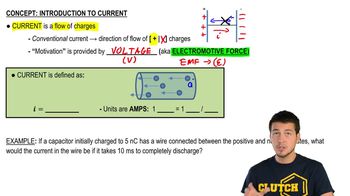
Flow of electric charge, typically measured in amperes, representing charge passing through a point per unit time.
Conventional Current
Direction of current flow assumed to be positive charges, opposite to the actual electron flow.
Potential Difference
Voltage between two points that motivates charge movement, also known as electromotive force.
Electromotive Force
Another term for potential difference, not an actual force, but drives electron movement.
Amperes
Unit of electric current, equivalent to one coulomb of charge passing a point per second.
Capacitor
Device that stores electrical energy in an electric field, used in the example to calculate current.
Nano Coulombs
Unit of electric charge, equal to 10^-9 coulombs, used in the example calculation.
Milliamp
One thousandth of an ampere, used to measure small currents in the example.
Elementary Charge
Fundamental charge unit, approximately 1.6 x 10^-19 coulombs, used to calculate electron numbers.
Cross-sectional Area
Area through which charge flows, used to define current as charge per time.
Electron Flow
Actual movement of electrons, opposite to the direction of conventional current.
 뒤로뒤로
뒤로뒤로
 05:38
05:38