Physics
나의 코스
배우기
시험 준비
AI 튜터
학습 가이드
교과서적 해결책
플래시카드
탐험해 보세요
앱을 사용해 보세요
나의 코스
배우기
시험 준비
AI 튜터
학습 가이드
교과서적 해결책
플래시카드
탐험해 보세요
앱을 사용해 보세요
뒤로
Work Done Through Multiple Processes quiz
카드를 뒤집기 위해 탭할 수 있습니다.
How do you calculate the total work done in multiple thermodynamic processes?
카드를 뒤집기 위해 탭할 수 있습니다.
👆
How do you calculate the total work done in multiple thermodynamic processes?
The total work is the sum of the individual works done in each process.
진행 상황 추적
컨트롤 버튼이 '내비게이션' 모드로 변경되었습니다.
1/15
관련 플래시카드
관련 실천
추천 영상
Work Done Through Multiple Processes definitions
Work Done Through Multiple Processes
15 용어
Work Done Through Multiple Processes
22. The First Law of Thermodynamics
3 문제점
주제
Patrick
Cyclic Thermodynamic Processes
22. The First Law of Thermodynamics
5 문제점
주제
Patrick
22. The First Law of Thermodynamics
5 주제
13 문제점
장
Patrick
07:44
Calculating Works For Multiple Thermodynamic Processes
4028
views
41
rank
이 집합의 용어 (15)
하이드의 정의
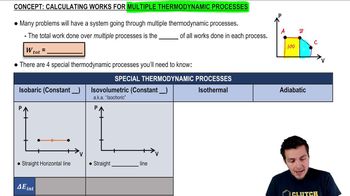
How do you calculate the total work done in multiple thermodynamic processes?
The total work is the sum of the individual works done in each process.
What is the equation for work done in an isobaric process?
The equation is W = P * ΔV, where P is pressure and ΔV is the change in volume.
What does 'isobaric' mean in thermodynamics?
Isobaric means the process occurs at constant pressure.
What is the work done during an isovolumetric process?
The work done is zero because there is no change in volume (ΔV = 0).
How is an isobaric process represented on a PV diagram?
It is shown as a straight horizontal line, indicating constant pressure.
How is an isovolumetric process represented on a PV diagram?
It is shown as a straight vertical line, indicating constant volume.
If a process goes from point A to B to C, how do you find the total work?
Add the work done from A to B and the work done from B to C.
Why can't you use W = P * ΔV for an isovolumetric process?
Because ΔV is zero, so the work is always zero regardless of pressure changes.
In the example, what is the total work done for the path A to B to C?
The total work is 12,000 joules.
In the example, what is the total work done for the path A to D to C?
The total work is 6,000 joules.
What does it mean when we say work is 'path dependent' in thermodynamics?
It means the amount of work done depends on the specific path taken between two states.
What is the significance of the area under the curve in a PV diagram?
The area under the curve represents the work done during the process.
What is another name for an isovolumetric process?
It is also called an isochoric process.
If a process has constant volume but changing pressure, what is the work done?
The work done is zero because the volume does not change.
How do you determine the sign of work in an isobaric process?
If the volume increases (expansion), work is positive; if volume decreases (compression), work is negative.