Skip to main content
Physics with Calculus
나의 코스
배우기
시험 준비
AI 튜터
학습 가이드
교과서적 해결책
플래시카드
탐험해 보세요
앱을 사용해 보세요
나의 코스
배우기
시험 준비
AI 튜터
학습 가이드
교과서적 해결책
플래시카드
탐험해 보세요
앱을 사용해 보세요
뒤로
More 2D Equilibrium Problems quiz
카드를 뒤집기 위해 탭할 수 있습니다.
What does it mean for a beam to be held at equilibrium?
카드를 뒤집기 위해 탭할 수 있습니다.
👆
What does it mean for a beam to be held at equilibrium?
It means the sum of all forces and the sum of all torques acting on the beam are zero.
진행 상황 추적
컨트롤 버튼이 '내비게이션' 모드로 변경되었습니다.
1/15
관련 플래시카드
관련 실천
추천 영상
More 2D Equilibrium Problems definitions
More 2D Equilibrium Problems
15 용어
More 2D Equilibrium Problems
15. Rotational Equilibrium
3 문제점
주제
Patrick
Review: Center of Mass
15. Rotational Equilibrium
5 문제점
주제
15. Rotational Equilibrium - Part 1 of 2
4 주제
9 문제점
장
Patrick
15. Rotational Equilibrium - Part 2 of 2
4 주제
12 문제점
장
Patrick
VideoThumbView.guidedCourse
15:00
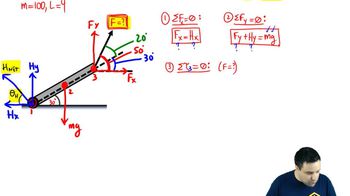
Inclined beam against the floor
5477
views
24
rank
5
comments
이 집합의 용어 (15)
하이드의 정의
What does it mean for a beam to be held at equilibrium?
It means the sum of all forces and the sum of all torques acting on the beam are zero.
What are the two main types of equations used to solve 2D equilibrium problems?
Force equations (sum of forces in x and y axes) and torque equations (sum of torques about a reference axis) are used.
How is the force f applied to the beam described in terms of direction?
The force f is applied at 50 degrees above the horizontal.
What is the relationship between the x-components of the applied force and the hinge force?
The x-component of the applied force (f_x) is equal in magnitude and opposite in direction to the hinge force (h_x).
How do you express the y-components of forces in equilibrium for the beam?
The sum of the y-components of the applied force and hinge force equals the weight of the beam: f_y + h_y = mg.
Why is it important to choose the correct point about which to write the torque equation?
Choosing a point away from the target variable ensures the variable appears in the equation, allowing you to solve for it.
What is the formula for torque due to a force?
Torque is given by τ = r × F × sin(θ), where r is the distance from the axis, F is the force, and θ is the angle between r and F.
What is the direction of the torque produced by the beam's weight?
The torque produced by the beam's weight is clockwise, so it is considered negative.
How do you determine the angle to use in the torque equation for the beam's weight?
You use the complementary angle to the beam's inclination, which is 60 degrees in this example.
What is the distance used for the torque calculation of the beam's weight?
The distance is half the length of the beam, so r = 2 meters for the weight.
How do you find the x and y components of the applied force f?
The x-component is f_x = f cos(θ), and the y-component is f_y = f sin(θ), where θ is the angle of the force.
What is the value of the hinge force's y-component (h_y) in this example?
h_y = mg - f_y, which calculates to 30 N in this example.
How do you calculate the magnitude of the net hinge force?
The magnitude is found using the Pythagorean theorem: h_net = sqrt(h_x^2 + h_y^2).
How do you determine the direction (angle) of the net hinge force?
The angle is found using θ = arctan(h_y / h_x), which gives 2.1 degrees in this example.
Why is the sign of h_x negative in this problem?
h_x is negative because it acts to the left, opposing the rightward x-component of the applied force.
 뒤로뒤로
뒤로뒤로
 15:00
15:00