Skip to main content
Physics with Calculus
나의 코스
배우기
시험 준비
AI 튜터
학습 가이드
교과서적 해결책
플래시카드
탐험해 보세요
앱을 사용해 보세요
나의 코스
배우기
시험 준비
AI 튜터
학습 가이드
교과서적 해결책
플래시카드
탐험해 보세요
앱을 사용해 보세요
뒤로
More Connect Wheels (Bicycles) quiz
카드를 뒤집기 위해 탭할 수 있습니다.
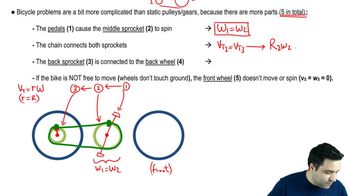
What are the five main parts involved in a typical bicycle physics problem?
카드를 뒤집기 위해 탭할 수 있습니다.
👆
What are the five main parts involved in a typical bicycle physics problem?
The five main parts are the pedals, middle sprocket, back sprocket, back wheel, and front wheel.
진행 상황 추적
컨트롤 버튼이 '내비게이션' 모드로 변경되었습니다.
1/15
관련 플래시카드
관련 실천
추천 영상
More Connect Wheels (Bicycles) definitions
More Connect Wheels (Bicycles)
15 용어
More Connect Wheels (Bicycles)
12. Rotational Kinematics
5 문제점
주제
Rotational Velocity & Acceleration
12. Rotational Kinematics
5 문제점
주제
Patrick
12. Rotational Kinematics - Part 1 of 2
3 주제
8 문제점
장
Patrick
12. Rotational Kinematics - Part 2 of 2
5 주제
12 문제점
장
Patrick
VideoThumbView.guidedCourse
07:45
Bicycle Problems (Moving)
4069
views
28
rank
VideoThumbView.guidedCourse
09:47
Bicycle Problems (Static)
5658
views
47
rank
1
comments
VideoThumbView.guidedCourse
04:50
Angular speeds of moving bicyle
3611
views
42
rank
이 집합의 용어 (15)
하이드의 정의
What are the five main parts involved in a typical bicycle physics problem?
The five main parts are the pedals, middle sprocket, back sprocket, back wheel, and front wheel.
How are the angular velocities of the pedals and the middle sprocket related?
The angular velocities of the pedals and the middle sprocket are equal because they spin together on the same axis.
What equation relates the tangential velocities at the edges of the middle and back sprockets connected by a chain?
The equation is R2*omega2 = R3*omega3, where R is the radius and omega is the angular velocity.
How are the angular velocities of the back sprocket and the back wheel related?
The angular velocities of the back sprocket and the back wheel are equal because they are directly connected and spin together.
What happens to the front wheel when a bike is lifted off the ground and the pedals are spun?
The front wheel does not spin because it is not connected to the moving parts and does not touch the ground.
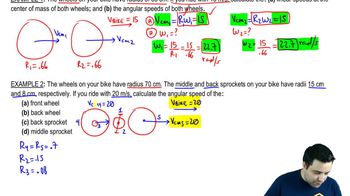
If the middle sprocket has a diameter of 0.16 m and the back sprocket has a diameter of 0.10 m, what are their radii?
The radius of the middle sprocket is 0.08 m and the radius of the back sprocket is 0.05 m.
If the pedals spin at 8 radians per second, what is the angular velocity of the middle sprocket?
The angular velocity of the middle sprocket is also 8 radians per second.
How do you calculate the angular velocity of the back sprocket given the radii and angular velocity of the middle sprocket?
Use omega3 = (R2*omega2)/R3, where R2 and omega2 are for the middle sprocket and R3 is for the back sprocket.
What is the angular velocity of the back wheel if the back sprocket's angular velocity is 12.8 radians per second?
The angular velocity of the back wheel is also 12.8 radians per second.
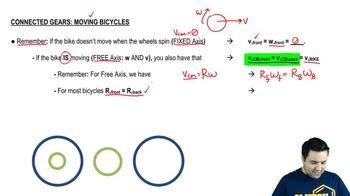
When a bike is free to move, how do the linear velocities of the front and back wheels compare?
The linear velocities of the front and back wheels are equal because they move together as the bike moves.
What is the formula for the linear velocity of the center of mass of a rolling wheel?
The formula is V_cm = R*omega, where R is the radius and omega is the angular velocity.
If both wheels of a bike have a radius of 0.66 m and the bike moves at 15 m/s, what is the angular velocity of each wheel?
The angular velocity of each wheel is 15 / 0.66 = 22.7 radians per second.
If the radii of the front and back wheels are equal, how do their angular velocities compare?
Their angular velocities are equal because the ratio R*omega is the same for both wheels.
What is the linear velocity of the center of mass of each wheel if the bike moves at 10 m/s?
The linear velocity of the center of mass of each wheel is 10 m/s.
In a static bike scenario, what are the values of the linear and angular velocities of the front wheel?
Both the linear and angular velocities of the front wheel are zero.
 뒤로뒤로
뒤로뒤로
 07:45
07:45