Physics
나의 코스
배우기
시험 준비
AI 튜터
학습 가이드
교과서적 해결책
플래시카드
탐험해 보세요
앱을 사용해 보세요
나의 코스
배우기
시험 준비
AI 튜터
학습 가이드
교과서적 해결책
플래시카드
탐험해 보세요
앱을 사용해 보세요
뒤로
Work As Area Under F-x Graphs quiz
카드를 뒤집기 위해 탭할 수 있습니다.
What does the area under a force versus displacement (F-x) graph represent?
카드를 뒤집기 위해 탭할 수 있습니다.
👆
What does the area under a force versus displacement (F-x) graph represent?
The area under an F-x graph represents the work done by the force on the object.
진행 상황 추적
컨트롤 버튼이 '내비게이션' 모드로 변경되었습니다.
1/15
관련 플래시카드
관련 실천
추천 영상
Work As Area Under F-x Graphs definitions
Work As Area Under F-x Graphs
15 용어
Work As Area Under F-x Graphs
9. Work & Energy
1 문제
주제
David-Paige
9. Work & Energy - Part 1 of 2
3 주제
8 문제점
장
Patrick
9. Work & Energy - Part 2 of 2
4 주제
9 문제점
장
David-Paige
04:05
Calculating Work As Area Under F-x Graphs
9448
views
123
rank
03:53
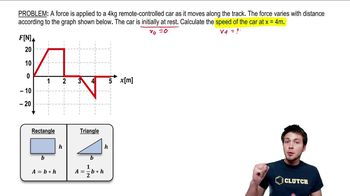
Speed of a Remote Controlled Car Using F-x Graph
7493
views
127
rank
4
comments
이 집합의 용어 (15)
하이드의 정의
What does the area under a force versus displacement (F-x) graph represent?
The area under an F-x graph represents the work done by the force on the object.
How do you calculate the area of a rectangle on a force-displacement graph?
You calculate the area of a rectangle by multiplying its base by its height.
What formula is used to find the area of a triangle on a force-displacement graph?
The area of a triangle is found using the formula one-half base times height.
How do you determine the total work done from a force-displacement graph with multiple shapes?
Add the areas of all the shapes (rectangles and triangles), considering their signs, to get the total work done.
What does a positive area above the x-axis on an F-x graph indicate?
A positive area above the x-axis indicates positive work, meaning the force is in the direction of displacement.
What does a negative area below the x-axis on an F-x graph represent?
A negative area below the x-axis represents negative work, where the force acts opposite to the displacement.
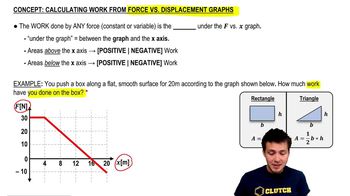
If a rectangle on an F-x graph has a base of 4 and a height of 30, what is its area?
The area is 4 times 30, which equals 120 joules.
How do you calculate the area of a triangle with a base of 12 and a height of 30 on an F-x graph?
The area is one-half times 12 times 30, which equals 180 joules.
If a triangle below the x-axis has a base of 4 and a height of -10, what is its area?
The area is one-half times 4 times -10, which equals -20 joules.
How do you find the net work done when there are both positive and negative areas on the F-x graph?
Sum all the positive and negative areas to find the net work done.
Why might using an F-x graph be easier than using the formula W = Fd cosθ for variable forces?
Because you can visually break the graph into simple shapes and sum their areas, avoiding complex calculations with average forces.
What is the total work done if the areas under the F-x graph are 120 J, 180 J, and -20 J?
The total work done is 120 + 180 + (-20) = 280 joules.
What should you do if the force on the F-x graph changes direction (crosses the x-axis)?
Calculate the area for each section separately, assigning positive or negative signs based on their position relative to the x-axis.
What does the phrase 'area under the graph' mean in the context of work and F-x graphs?
It means the area between the force-displacement curve and the x-axis.
What is the main advantage of using the area under an F-x graph to calculate work for variable forces?
It simplifies the calculation by allowing you to use basic geometry instead of more complex formulas involving average forces.