Physics
나의 코스
배우기
시험 준비
AI 튜터
학습 가이드
교과서적 해결책
플래시카드
탐험해 보세요
앱을 사용해 보세요
나의 코스
배우기
시험 준비
AI 튜터
학습 가이드
교과서적 해결책
플래시카드
탐험해 보세요
앱을 사용해 보세요
뒤로
Newton's First & Second Laws quiz
카드를 뒤집기 위해 탭할 수 있습니다.
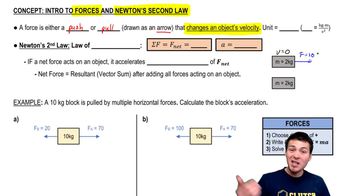
What is the relationship described by Newton's second law?
카드를 뒤집기 위해 탭할 수 있습니다.
👆
What is the relationship described by Newton's second law?
Newton's second law states that the net force acting on an object is equal to the mass of the object multiplied by its acceleration (F=ma).
진행 상황 추적
컨트롤 버튼이 '내비게이션' 모드로 변경되었습니다.
1/9
관련 플래시카드
관련 실천
추천 영상
Newton's First & Second Laws definitions
Newton's First & Second Laws
15 용어
Newton's First & Second Laws quiz #1
Newton's First & Second Laws
40 용어
Newton's First & Second Laws quiz #2
Newton's First & Second Laws
40 용어
Newton's First & Second Laws
6. Intro to Forces (Dynamics)
7 문제점
주제

Patrick
Types Of Forces & Free Body Diagrams
6. Intro to Forces (Dynamics)
7 문제점
주제
Patrick
6. Intro to Forces (Dynamics) - Part 1 of 2
4 주제
12 문제점
장
Patrick
6. Intro to Forces (Dynamics) - Part 2 of 2
5 주제
11 문제점
장
Patrick
04:46
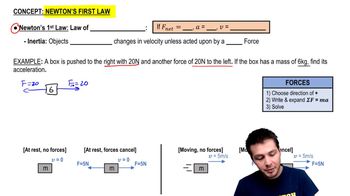
Newton's 1st Law
16833
views
721
rank
3
comments
04:58
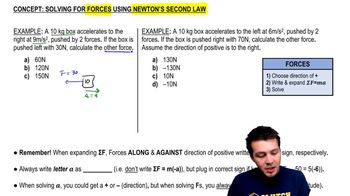
Solving for Forces Using Newton's Second Law
18145
views
565
rank
5
comments
06:54
Intro to Forces & Newton's Second Law
26595
views
1026
rank
이 집합의 용어 (9)
하이드의 정의
What is the relationship described by Newton's second law?
Newton's second law states that the net force acting on an object is equal to the mass of the object multiplied by its acceleration (F=ma).
How do you determine the direction of acceleration according to Newton's second law?
The direction of acceleration is determined by the direction of the net force acting on the object.
What is the significance of choosing a consistent direction for positive when calculating forces?
Choosing a consistent direction for positive is crucial for correctly applying signs to the values of forces and acceleration.
How do you calculate the net force when multiple forces act on an object?
The net force is calculated by vector addition of all individual forces, considering their directions.
What does Newton's first law, also known as the law of inertia, state?
Newton's first law states that an object will maintain its state of motion unless acted upon by a net external force.
How does mass relate to an object's resistance to changes in velocity?
A larger mass implies greater resistance to acceleration under the same net force, indicating more inertia.
What happens to an object's velocity if the net force acting on it is zero?
If the net force is zero, the object's velocity remains constant, meaning it either stays at rest or continues moving at a constant speed.
How do you solve for acceleration using Newton's second law?
Acceleration can be calculated by dividing the net force by the mass of the object (a = F_net/m).
What does a negative acceleration indicate in terms of direction?
A negative acceleration indicates that the acceleration is in the opposite direction to the chosen positive direction.