Skip to main content
Physics with Calculus
나의 코스
배우기
시험 준비
AI 튜터
학습 가이드
교과서적 해결책
플래시카드
탐험해 보세요
앱을 사용해 보세요
나의 코스
배우기
시험 준비
AI 튜터
학습 가이드
교과서적 해결책
플래시카드
탐험해 보세요
앱을 사용해 보세요
뒤로
Parallel Axis Theorem quiz
카드를 뒤집기 위해 탭할 수 있습니다.
What does the Parallel Axis Theorem allow you to calculate?
카드를 뒤집기 위해 탭할 수 있습니다.
👆
What does the Parallel Axis Theorem allow you to calculate?
It allows you to calculate the moment of inertia about any axis parallel to one through the center of mass.
진행 상황 추적
컨트롤 버튼이 '내비게이션' 모드로 변경되었습니다.
1/15
관련 플래시카드
관련 실천
추천 영상
Parallel Axis Theorem definitions
Parallel Axis Theorem
15 용어
Parallel Axis Theorem
13. Rotational Inertia & Energy
5 문제점
주제
Patrick
Intro to Moment of Inertia
13. Rotational Inertia & Energy
6 문제점
주제
Patrick
13. Rotational Inertia & Energy - Part 1 of 2
5 주제
11 문제점
장
David-Paige
13. Rotational Inertia & Energy - Part 2 of 2
7 주제
12 문제점
장
David-Paige
VideoThumbView.guidedCourse
13:46
Parallel Axis Theorem
8879
views
74
rank
4
comments
이 집합의 용어 (15)
하이드의 정의
What does the Parallel Axis Theorem allow you to calculate?
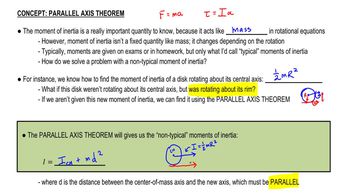
It allows you to calculate the moment of inertia about any axis parallel to one through the center of mass.
What is the formula for the Parallel Axis Theorem?
I = I_cm + M d^2, where I_cm is the moment of inertia about the center of mass, M is the mass, and d is the distance between axes.
Why is the moment of inertia considered a relative quantity?
Because it depends on the axis of rotation, unlike mass which is fixed.
What is the standard moment of inertia for a uniform disk about its center?
It is (1/2)MR^2, where M is the mass and R is the radius.
How do you find the moment of inertia of a disk about its rim?
Apply the Parallel Axis Theorem: I = (1/2)MR^2 + MR^2 = (3/2)MR^2.
What is the moment of inertia of a disk about an axis halfway to the rim?
It is (3/4)MR^2, found by adding (1/2)MR^2 and (1/4)MR^2.
What must be true about the axes when using the Parallel Axis Theorem?
The axes must be parallel to each other.
What is the moment of inertia of a thin rod about an axis at its end?
It is (1/3)ML^2, where M is the mass and L is the length.
How do you find the moment of inertia of a thin rod about its center of mass?
Use the Parallel Axis Theorem in reverse: I_cm = (1/3)ML^2 - (1/4)ML^2 = (1/12)ML^2.
What is the moment of inertia of a thin rod about an axis halfway between the center and the edge?
It is (7/48)ML^2, calculated using the Parallel Axis Theorem.
Why can't you use the Parallel Axis Theorem directly from the edge to halfway to the edge for a rod?
Because the theorem requires the moment of inertia about the center of mass, not the edge.
What is the value of d in the Parallel Axis Theorem for a disk rotating about its rim?
d equals the radius R of the disk.
If the axis is a distance x from the center of mass, what term do you add to I_cm?
You add Mx^2 to I_cm.
What is the first step when using the Parallel Axis Theorem for a non-standard axis?
Find or know the moment of inertia about the center of mass.
How does the moment of inertia halfway to the rim compare to that at the rim for a disk?
It is exactly half the moment of inertia at the rim.
 뒤로뒤로
뒤로뒤로

 13:46
13:46