Skip to main content
Physics with Calculus
나의 코스
배우기
시험 준비
AI 튜터
학습 가이드
교과서적 해결책
플래시카드
탐험해 보세요
앱을 사용해 보세요
나의 코스
배우기
시험 준비
AI 튜터
학습 가이드
교과서적 해결책
플래시카드
탐험해 보세요
앱을 사용해 보세요
뒤로
Phasors for Resistors quiz
카드를 뒤집기 위해 탭할 수 있습니다.
What does it mean for voltage and current to be 'in phase' across a resistor in an AC circuit?
카드를 뒤집기 위해 탭할 수 있습니다.
👆
What does it mean for voltage and current to be 'in phase' across a resistor in an AC circuit?
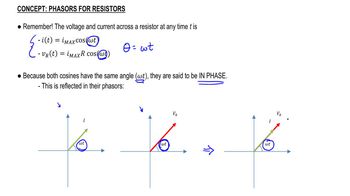
It means that both voltage and current have the same angle (omega t) at any time, so their phasors line up perfectly.
진행 상황 추적
컨트롤 버튼이 '내비게이션' 모드로 변경되었습니다.
1/15
관련 플래시카드
관련 실천
추천 영상
Phasors for Resistors definitions
Phasors for Resistors
12 용어
Phasors for Resistors
31. Alternating Current
5 문제점
주제
Capacitors in AC Circuits
31. Alternating Current
7 문제점
주제
Patrick
31. Alternating Current - Part 1 of 3
5 주제
11 문제점
장
Patrick
31. Alternating Current - Part 2 of 3
6 주제
14 문제점
장
Patrick
31. Alternating Current - Part 3 of 3
2 주제
6 문제점
장
VideoThumbView.guidedCourse
04:11
Phasors for Resistors
3825
views
29
rank
1
comments
이 집합의 용어 (15)
하이드의 정의
What does it mean for voltage and current to be 'in phase' across a resistor in an AC circuit?
It means that both voltage and current have the same angle (omega t) at any time, so their phasors line up perfectly.
What is the general equation for the angle of a phasor in an AC circuit?
The angle for any phasor is given by omega t, where omega is the angular frequency and t is time.
If the angular frequency is 20 s⁻¹ and the circuit is closed for 0.2 seconds, what is the phasor angle?
The angle is omega times t, so 20 × 0.2 = 4 radians.
How many degrees is 4 radians approximately equal to?
4 radians is approximately 229 degrees.
In which quadrant does a phasor at 229 degrees lie?
A phasor at 229 degrees lies in the third quadrant.
When drawing phasors for voltage and current across a resistor, how should they be oriented?
They should be lined up at the same angle, since they are in phase.
What happens to the voltage and current phasors as they rotate over time in a resistor?
They remain lined up and always point in the same direction because they are in phase.
What is the key takeaway about voltage and current in resistors in AC circuits?
The voltage across the resistor is always in phase with the current through the resistor.
What does 'omega' represent in the context of phasors?
'Omega' represents the angular frequency of the AC source.
If you choose a different time to measure the phasors, what must remain the same for voltage and current?
Their angles must still match, so they remain in phase.
What is the significance of the circuit being 'broken' before closing in the example?
When the circuit is broken, nothing happens; time starts counting once the circuit is closed.
Does the color used to draw phasors on a diagram affect their meaning?
No, the color does not matter as long as the angles are correct.
What mathematical operation do you use to find the phasor angle from angular frequency and time?
You multiply the angular frequency (omega) by the time (t).
Why is it important to remember that voltage and current are in phase for resistors?
Because it helps in analyzing and drawing phasor diagrams for AC circuits with resistors.
Can you draw the voltage and current phasors at any angle as long as they match?
Yes, as long as both phasors are at the same angle, they are in phase regardless of the specific value.
 뒤로
뒤로
 04:11
04:11