Skip to main content
Physics with Calculus
나의 코스
배우기
시험 준비
AI 튜터
학습 가이드
교과서적 해결책
플래시카드
탐험해 보세요
앱을 사용해 보세요
나의 코스
배우기
시험 준비
AI 튜터
학습 가이드
교과서적 해결책
플래시카드
탐험해 보세요
앱을 사용해 보세요
뒤로
Solving Capacitor Circuits quiz
카드를 뒤집기 위해 탭할 수 있습니다.
What is the rule for finding equivalent capacitance in a series connection of capacitors?
카드를 뒤집기 위해 탭할 수 있습니다.
👆
What is the rule for finding equivalent capacitance in a series connection of capacitors?
Use the inverse sum rule: the inverse of the equivalent capacitance equals the sum of the inverses of individual capacitances.
진행 상황 추적
컨트롤 버튼이 '내비게이션' 모드로 변경되었습니다.
1/15
관련 플래시카드
관련 실천
추천 영상
Solving Capacitor Circuits definitions
Solving Capacitor Circuits
15 용어
Solving Capacitor Circuits
26. Capacitors & Dielectrics
4 문제점
주제
Patrick
Intro To Dielectrics
26. Capacitors & Dielectrics
3 문제점
주제
Patrick
26. Capacitors & Dielectrics - Part 1 of 2
4 주제
7 문제점
장
David-Paige
26. Capacitors & Dielectrics - Part 2 of 2
4 주제
8 문제점
장
Patrick
VideoThumbView.guidedCourse
11:02
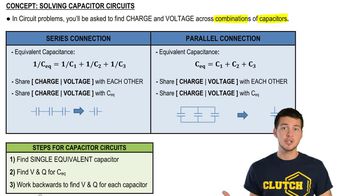
Solving Capacitor Circuits
9803
views
176
rank
5
comments
VideoThumbView.guidedCourse
02:25
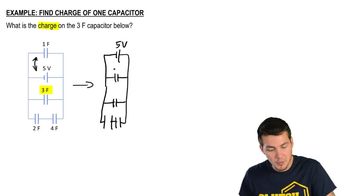
Find Charge of One Capacitor (Simple)
5789
views
102
rank
2
comments
이 집합의 용어 (15)
하이드의 정의
What is the rule for finding equivalent capacitance in a series connection of capacitors?
Use the inverse sum rule: the inverse of the equivalent capacitance equals the sum of the inverses of individual capacitances.
How do capacitors in series share charge?
Capacitors in series all have the same charge, which is also the charge on the equivalent capacitance.
What is the rule for finding equivalent capacitance in a parallel connection of capacitors?
The equivalent capacitance is the sum of the individual capacitances.
What do capacitors in parallel share with each other?
Capacitors in parallel share the same voltage across each capacitor.
What is the relationship between charge (Q), capacitance (C), and voltage (V) in a capacitor?
The relationship is Q = C × V.
What is the first step in solving a capacitor circuit problem?
Find the single equivalent capacitance for the entire circuit.
After finding the equivalent capacitance, what should you determine next?
Determine the voltage and charge across the equivalent capacitor using Q = C × V.
How do you find the charge on each capacitor in a series configuration?
Each capacitor in series has the same charge as the equivalent capacitance.
How do you find the voltage across each capacitor in a series configuration?
Use V = Q / C for each capacitor, where Q is the shared charge and C is the individual capacitance.
How do you find the voltage across each capacitor in a parallel configuration?
Each capacitor in parallel has the same voltage as the equivalent capacitance.
How do you find the charge on each capacitor in a parallel configuration?
Use Q = C × V for each capacitor, where V is the shared voltage and C is the individual capacitance.
In the example circuit, what is the equivalent capacitance of a 1 farad and 2 farad capacitor in parallel?
The equivalent capacitance is 1 + 2 = 3 farads.
How do you combine a 6 farad capacitor in series with a 3 farad equivalent capacitor?
Use the formula: (6 × 3) / (6 + 3) = 2 farads for the equivalent capacitance.
If the total voltage across the circuit is 10 volts and the equivalent capacitance is 2 farads, what is the total charge?
The total charge is Q = 2 × 10 = 20 coulombs.
What is the voltage across a 6 farad capacitor in series with a 3 farad equivalent capacitor, given a shared charge of 20 coulombs?
The voltage is V = Q / C = 20 / 6 = 3.33 volts.
 뒤로뒤로
뒤로뒤로

 11:02
11:02