Physics
나의 코스
배우기
시험 준비
AI 튜터
학습 가이드
교과서적 해결책
플래시카드
탐험해 보세요
앱을 사용해 보세요
나의 코스
배우기
시험 준비
AI 튜터
학습 가이드
교과서적 해결책
플래시카드
탐험해 보세요
앱을 사용해 보세요
뒤로
Solving Projectile Motion Using Energy quiz
카드를 뒤집기 위해 탭할 수 있습니다.
What is the main advantage of using energy conservation to solve projectile motion problems?
카드를 뒤집기 위해 탭할 수 있습니다.
👆
What is the main advantage of using energy conservation to solve projectile motion problems?
Energy conservation allows for quicker and more straightforward calculations of speeds and heights compared to traditional motion equations.
진행 상황 추적
컨트롤 버튼이 '내비게이션' 모드로 변경되었습니다.
1/15
관련 플래시카드
관련 실천
추천 영상
Solving Projectile Motion Using Energy definitions
Solving Projectile Motion Using Energy
15 용어
Solving Projectile Motion Using Energy
10. Conservation of Energy
5 문제점
주제
David-Paige
Motion Along Curved Paths
10. Conservation of Energy
5 문제점
주제
David-Paige
10. Conservation of Energy - Part 1 of 2
7 주제
15 문제점
장
Patrick
10. Conservation of Energy - Part 2 of 2
3 주제
8 문제점
장
04:27
Projectile Motion with Energy
8820
views
113
rank
2
comments
05:01
Calculating Max Height with Energy Conservation
7797
views
124
rank
5
comments
이 집합의 용어 (15)
하이드의 정의
What is the main advantage of using energy conservation to solve projectile motion problems?
Energy conservation allows for quicker and more straightforward calculations of speeds and heights compared to traditional motion equations.
What is the energy conservation equation used in projectile motion problems?
The equation is 1/2mv_a^2 + mgh_a = 1/2mv_d^2, where v_a is initial speed, h_a is initial height, and v_d is final speed.
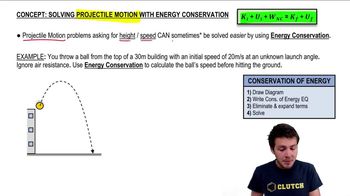
In the example, what is the initial height from which the ball is thrown?
The ball is thrown from a height of 30 meters above the ground.
What is the initial speed of the ball in the example problem?
The initial speed of the ball is 28 meters per second.
What happens to the mass variable in the energy conservation equation when solving for speed?
The mass cancels out from both sides of the equation since it appears in every term.
What is the gravitational potential energy at the ground level?
At ground level, gravitational potential energy is zero because the height is zero.
Why is the work done by non-conservative forces ignored in this example?
It is ignored because air resistance is neglected and the problem starts after the ball leaves the hand, so no work is done by you.
What is the final speed of the ball just before it hits the ground according to the energy conservation calculation?
The final speed is approximately 31.4 meters per second.
How does energy conservation simplify solving projectile motion problems with unknown launch angles?
It eliminates the need to use complex motion equations and systems, making the calculation more straightforward.
What are the main forms of energy considered in the energy conservation equation for projectile motion?
The main forms are kinetic energy and gravitational potential energy.
At which point in the projectile's path is the gravitational potential energy highest?
It is highest at the initial point where the ball is at the top of the building.
What is the kinetic energy formula used in the energy conservation equation?
Kinetic energy is given by 1/2mv^2, where m is mass and v is velocity.
What is the gravitational potential energy formula used in the energy conservation equation?
Gravitational potential energy is mgh, where m is mass, g is gravity, and h is height.
Why is the energy conservation method considered more powerful for certain projectile motion problems?
Because it can solve problems more quickly and handle cases where traditional equations are cumbersome, such as unknown angles.
What is the value of g (acceleration due to gravity) used in the example calculation?
The value of g used is 9.8 meters per second squared.