Physics
나의 코스
배우기
시험 준비
AI 튜터
학습 가이드
교과서적 해결책
플래시카드
탐험해 보세요
앱을 사용해 보세요
나의 코스
배우기
시험 준비
AI 튜터
학습 가이드
교과서적 해결책
플래시카드
탐험해 보세요
앱을 사용해 보세요
뒤로
Special Equations in Symmetrical Launches quiz
카드를 뒤집기 위해 탭할 수 있습니다.
What is a symmetrical launch in projectile motion?
카드를 뒤집기 위해 탭할 수 있습니다.
👆
What is a symmetrical launch in projectile motion?
A symmetrical launch is when the projectile's final height equals its initial height, making the motion symmetric about the peak.
진행 상황 추적
컨트롤 버튼이 '내비게이션' 모드로 변경되었습니다.
1/15
관련 플래시카드
관련 실천
추천 영상
Special Equations in Symmetrical Launches definitions
Special Equations in Symmetrical Launches
15 용어
Special Equations in Symmetrical Launches
5. Projectile Motion
1 문제
주제
Positive (Upward) Launch
5. Projectile Motion
6 문제점
주제
Patrick
5. Projectile Motion
6 주제
14 문제점
장
Patrick
03:34
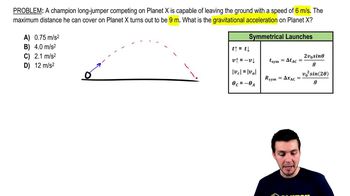
A Long Jump on Planet X
3895
views
37
rank
2
comments
07:51
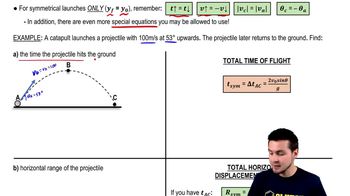
Using Special Equations in Symmetrical Launch Problems
6245
views
63
rank
2
comments
이 집합의 용어 (15)
하이드의 정의
What is a symmetrical launch in projectile motion?
A symmetrical launch is when the projectile's final height equals its initial height, making the motion symmetric about the peak.
What is the relationship between the time to ascend and the time to descend in a symmetrical launch?
The time to ascend equals the time to descend in a symmetrical launch.
How does the initial upward velocity compare to the final downward velocity in a symmetrical launch?
The initial upward velocity is equal in magnitude but opposite in direction to the final downward velocity.
What is the special equation for total time of flight in a symmetrical launch?
The total time of flight is T = 2 * V0 * sin(theta) / g, where V0 is initial velocity, theta is launch angle, and g is gravity.
When can you use the equation T = 2 * V0 * sin(theta) / g?
You can use this equation only for symmetrical launches where the projectile lands at the same height it was launched.
How do you calculate the horizontal range if you already know the total time of flight?
The horizontal range R is calculated as R = Vx * T, where Vx is the horizontal velocity and T is the total time of flight.
What is the range equation for a symmetrical projectile launch?
The range equation is R = V0^2 * sin(2*theta) / g.
What is the x-component of the initial velocity in projectile motion?
The x-component is V0 * cos(theta), where V0 is the initial velocity and theta is the launch angle.
At what launch angle is the horizontal range of a projectile maximized?
The horizontal range is maximized at a launch angle of 45 degrees.
What are complementary launch angles in projectile motion?
Complementary launch angles are two angles that add up to 90 degrees, such as 30° and 60°.
How do complementary angles affect the range of a projectile?
For the same initial velocity, complementary angles yield the same horizontal range.
If a projectile is launched at 53°, what other angle will give the same range?
The complementary angle, 37°, will give the same range because 53° + 37° = 90°.
What is the horizontal range if V0 = 100 m/s and theta = 53° or 37°?
The horizontal range is 980 meters for both angles.
Why do the equations R = Vx * T and R = V0^2 * sin(2*theta) / g give the same result?
Both equations are derived from the same principles and are equivalent for symmetrical launches.
What must be true about the initial and final heights to use the special symmetrical launch equations?
The initial and final heights must be equal for the special symmetrical launch equations to apply.