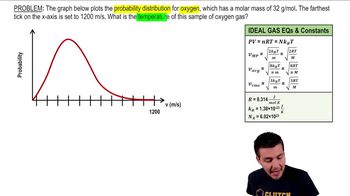
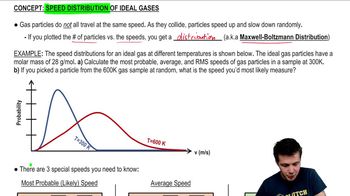
What is the Maxwell-Boltzmann distribution in the context of ideal gases?
It is a curve that shows the number of gas particles versus their speeds, illustrating the probability of finding particles at various speeds in an ideal gas.
How is the most probable speed (V_MP) identified on a Maxwell-Boltzmann distribution curve?
It is the speed corresponding to the peak (highest point) of the distribution curve.
What is the formula for the most probable speed (V_MP) of an ideal gas?
V_MP = sqrt(2RT/M), where R is the gas constant, T is temperature, and M is molar mass.
How does the formula for RMS speed (V_RMS) differ from that of the most probable speed?
The RMS speed formula uses a 3 under the square root (V_RMS = sqrt(3RT/M)), while the most probable speed uses a 2 (V_MP = sqrt(2RT/M)).
What is the formula for the average speed (V_avg) of an ideal gas?
V_avg = sqrt((8RT)/(πM)), where R is the gas constant, T is temperature, and M is molar mass.
How does the average speed (V_avg) compare to the most probable and RMS speeds?
The average speed is greater than the most probable speed but less than the RMS speed.
Why is the RMS speed typically higher than the average speed?
Because RMS speed is calculated using the squares of the speeds, which skews the value toward higher numbers.
What are the calculated values of V_MP, V_avg, and V_RMS for a gas at 300 K with M = 0.028 kg/mol?
 뒤로
뒤로
 07:59
07:59