Skip to main content
Physics with Calculus
나의 코스
배우기
시험 준비
AI 튜터
학습 가이드
교과서적 해결책
플래시카드
탐험해 보세요
앱을 사용해 보세요
나의 코스
배우기
시험 준비
AI 튜터
학습 가이드
교과서적 해결책
플래시카드
탐험해 보세요
앱을 사용해 보세요
뒤로
Standing Sound Waves quiz
카드를 뒤집기 위해 탭할 수 있습니다.
What type of wave are sound waves in pipes: longitudinal or transverse?
카드를 뒤집기 위해 탭할 수 있습니다.
👆
What type of wave are sound waves in pipes: longitudinal or transverse?
Sound waves in pipes are longitudinal waves.
진행 상황 추적
컨트롤 버튼이 '내비게이션' 모드로 변경되었습니다.
1/15
관련 플래시카드
관련 실천
추천 영상
Standing Sound Waves definitions
Standing Sound Waves
15 용어
Standing Sound Waves
18. Waves & Sound
4 문제점
주제
Patrick
Beats
18. Waves & Sound
4 문제점
주제
Patrick
18. Waves & Sound - Part 1 of 3
6 주제
11 문제점
장
Patrick
18. Waves & Sound - Part 2 of 3
4 주제
10 문제점
장
Patrick
18. Waves & Sound - Part 3 of 3
6 주제
12 문제점
장
Patrick
VideoThumbView.guidedCourse
05:17
Standing Sound Waves
5940
views
92
rank
4
comments
VideoThumbView.guidedCourse
03:24
Example 1
3921
views
83
rank
2
comments
이 집합의 용어 (15)
하이드의 정의
What type of wave are sound waves in pipes: longitudinal or transverse?
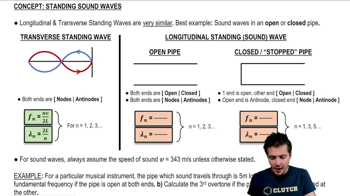
Sound waves in pipes are longitudinal waves.
In an open pipe, what is present at both ends: nodes or antinodes?
Both ends of an open pipe are antinodes.
In a closed pipe, what is present at the closed end and at the open end?
The closed end is a node, and the open end is an antinode.
What is the equation for the frequency of the nth harmonic in an open pipe?
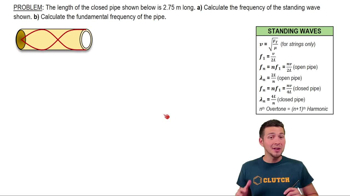
The frequency is given by f_n = n*v/(2L), where n is any integer.
What is the equation for the wavelength of the nth harmonic in an open pipe?
The wavelength is λ_n = 2L/n.
What is the equation for the frequency of the nth harmonic in a closed pipe?
The frequency is f_n = n*v/(4L), where n is an odd integer.
What is the equation for the wavelength of the nth harmonic in a closed pipe?
The wavelength is λ_n = 4L/n, with n being odd.
What values can n take for harmonics in an open pipe?
n can be any positive integer: 1, 2, 3, and so on.
What values can n take for harmonics in a closed pipe?
n can only be odd integers: 1, 3, 5, etc.
What is the standard speed of sound used in these calculations unless otherwise specified?
The standard speed of sound is 343 m/s.
How do you calculate the fundamental frequency for an open pipe of length L?
Use f_1 = v/(2L), where v is the speed of sound.
How do you calculate the fundamental frequency for a closed pipe of length L?
Use f_1 = v/(4L), where v is the speed of sound.
For a closed pipe, what harmonic number corresponds to the third overtone?
The third overtone corresponds to n = 7.
If a closed pipe is 5 meters long, what is the frequency of the third overtone using v = 343 m/s?
The frequency is f_7 = 7*343/(4*5) = 120 Hz.
Why can't n = 2 be a harmonic in a closed pipe?
Because only odd harmonics are allowed in closed pipes due to the boundary conditions.
 뒤로뒤로
뒤로뒤로
 05:17
05:17