Skip to main content
Physics with Calculus
나의 코스
배우기
시험 준비
AI 튜터
학습 가이드
교과서적 해결책
플래시카드
탐험해 보세요
앱을 사용해 보세요
나의 코스
배우기
시험 준비
AI 튜터
학습 가이드
교과서적 해결책
플래시카드
탐험해 보세요
앱을 사용해 보세요
뒤로
Standing Waves quiz
카드를 뒤집기 위해 탭할 수 있습니다.
What is a standing wave?
카드를 뒤집기 위해 탭할 수 있습니다.
👆
What is a standing wave?
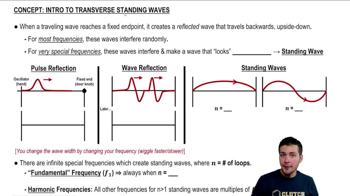
A standing wave is a wave pattern formed by the interference of two waves traveling in opposite directions, creating a stationary appearance.
진행 상황 추적
컨트롤 버튼이 '내비게이션' 모드로 변경되었습니다.
1/15
관련 플래시카드
관련 실천
추천 영상
Standing Waves definitions
Standing Waves
15 용어
Standing Waves
18. Waves & Sound
6 문제점
주제
Patrick
Standing Wave Functions
18. Waves & Sound
3 문제점
주제
Patrick
18. Waves & Sound - Part 1 of 3
6 주제
11 문제점
장
Patrick
18. Waves & Sound - Part 2 of 3
4 주제
10 문제점
장
Patrick
18. Waves & Sound - Part 3 of 3
6 주제
12 문제점
장
Patrick
VideoThumbView.guidedCourse
06:28
Equations for Transverse Standing Waves
5175
views
96
rank
VideoThumbView.guidedCourse
05:28
Example 1
3771
views
68
rank
1
comments
VideoThumbView.guidedCourse
07:58
Intro to Transverse Standing Waves
6710
views
150
rank
1
comments
이 집합의 용어 (15)
하이드의 정의
What is a standing wave?
A standing wave is a wave pattern formed by the interference of two waves traveling in opposite directions, creating a stationary appearance.
How is a standing wave created on a string tied to a fixed point?
A standing wave is created when you whip the string, causing waves to reflect and invert at the fixed end, leading to interference.
What happens to a wave pulse when it reaches a fixed endpoint?
The pulse is reflected and inverted, traveling back in the opposite direction.
What is the fundamental frequency in standing waves?
The fundamental frequency is the lowest frequency at which a standing wave can form, corresponding to n=1.
How do you calculate the fundamental frequency of a string?
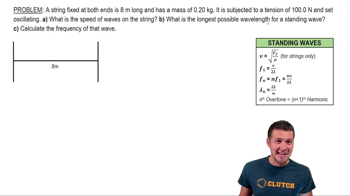
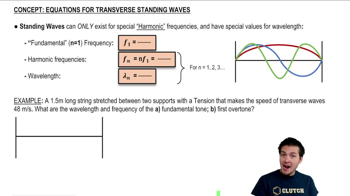
The fundamental frequency is calculated using f1 = v / (2l), where v is wave speed and l is string length.
What is the formula for the wavelength of a standing wave?
The wavelength is given by λ = 2l / n, where n is the number of loops.
How are harmonic frequencies related to the fundamental frequency?
Harmonic frequencies are integer multiples of the fundamental frequency, expressed as fn = n * f1.
What does n represent in standing wave equations?
n represents the number of loops or antinodes in the standing wave pattern.
What is the first overtone in terms of n?
The first overtone corresponds to n=2, which is the second harmonic.
How do you find the frequency for a standing wave with 5 loops?
Multiply the fundamental frequency by 5: f5 = 5 * f1.
Why can the wavelength of the fundamental frequency be longer than the string?
Because the fundamental standing wave only shows half a wavelength on the string, so the full wavelength is twice the string length.
What is the relationship between speed, frequency, and wavelength?
The relationship is v = λ * f, where v is speed, λ is wavelength, and f is frequency.
What is the wavelength for the first overtone on a 1.5 meter string?
The wavelength is 1.5 meters, equal to the length of the string.
What is the frequency of the fundamental tone for a 1.5 meter string with wave speed 48 m/s?
The fundamental frequency is 16 Hz, calculated as f1 = 48 / (2 * 1.5).
What is the frequency of the first overtone for the same string and speed?
The frequency is 32 Hz, which is twice the fundamental frequency.
 뒤로뒤로
뒤로뒤로
 06:28
06:28